Noam Chomsky Quotes
The change between horse and buggy to automobile is a big change and there hasn't been a major change since.
Chomsky, Noam. Understanding Power: The Indispensable Chomsky. Edited by Peter R. Mitchell and John Schoeffel, The New Press, 2002.


What Mises says in this quotation is true. What he does not say that by the time the automobile was developed and then the airplane, the Railroad monopoly had impeded and destroyed so many different entities that the governments had cracked down and curtailed much of the ability of the Railroads to exercise monopolist power. If the Railroads had as much power in 1920 as they did in 1870, there probably never would have been a thriving auto industry and the airlines would likely never have succeeded. Mises again exaggerates a basic point that large monopolistic companies and industries often have not been able to stave off new technology and approaches. While true in many cases, the cause is not necessarily fundamental to economics but has sometimes (as with the railroads) been caused by Government regulation and reform. A better example is that the large sail dominated shipping industry was not able to stop the coal fired steam engine ships. Indeed the shipping owners embraced the new technology. The best examples of Mises point occurred after Mises died. For example, Microsoft was not able to prevent Google from dominating many of Microsoft’s positions in the IT world.


Luddism was a British anti-technology movement whereby the Luddites sabotaged and destroyed manufacturing machinery.


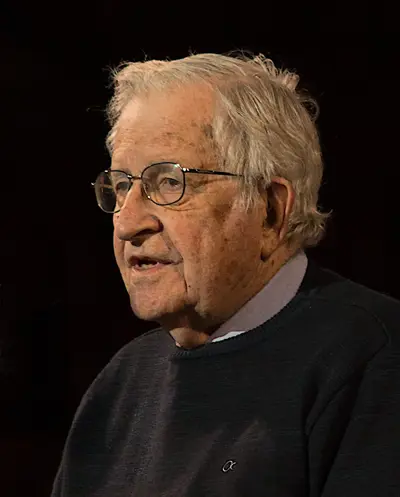
Avram Noam Chomsky is an American linguist, philosopher, cognitive scientist, historian, social critic, and political activist. Sometimes called "the father of modern linguistics", Chomsky is also a major figure in analytic philosophy and one of the founders of the field of cognitive science. He is Laureate Professor of Linguistics at the University of Arizona and Institute Professor Emeritus at the Massachusetts Institute of Technology (MIT), and is the author of more than 150 books on topics such as linguistics, war, politics, and mass media. Ideologically, he aligns with anarcho-syndicalism and libertarian socialism.
