Elihu Root Quotes
…the burden of proof rests always upon the advocates of change.
Elihu Root, 1845-1937, U. S. Secretary of War & U. S. Secretary of State, U. S. Senator (Republican, NY), Nobel Laureate in Peace, Speech, Albany New York, Constitutional Convention, April 6, 1915
Sourced by: Eigen's Political and Historical Quotations


This statement is very revealing in that it illustrates the attitude of the establishment of most developing nations. Traditional change is OK as long as it is not does transformational—ie as long as it does not make any meaningful changes. But modernization requires transformational change; without it there is no major reform and all institutions and power structures remain in their positions.
This is the ultimate extreme of conservatism which literally means to conserve what is. Salisbury argues that even if you truly believe that the status quo is bad, you should keep it as the risk of change and unexpected consequence is so great that it is not worth the risk. Interestingly, this is the same mode of thinking which created the command in the Koran for Muslims to live with a terrible Caliph or ruler (unless he is a blasphemer or heretic) rather than risk the instability of regime change. See {590195} and {593076} as examples.


Many conservatives of the 19th Century honestly believed that for a well-grounded man, it was impossible to make a radical moral or cultural change. Froude thought that it was but should be done very carefully and sparingly. See {636915}.


There are a few modern progressive conservatives who believe this point of view, but most generally resist change.


Samuel Langhorne Clemens, 1835-1910


5th Earl of Rosebery. At this point in history, America was growing rapidly, but had not yet become a dominant superpower. Rosebery was prescient enough to realize that although England was the great superpower of the time, the very conservative values were holding the nation back. He saw America as the model, even when England was still the dominant empire in the world.
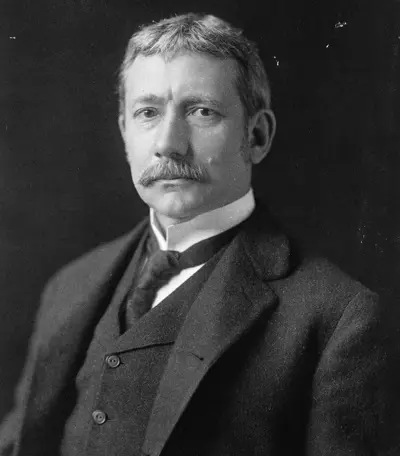
Elihu Root was an American lawyer and statesman who served as Secretary of State under President Theodore Roosevelt and as Secretary of War under Roosevelt and President William McKinley. He moved frequently between high-level appointed government positions in Washington, D.C. and private-sector legal practice in New York City. For that reason, he is sometimes considered to be the prototype of the 20th century political "wise man", advising presidents on a range of foreign and domestic issues. He was elected by the state legislature as a U.S. Senator from New York and served one term, 1909–1915. Root was awarded the Nobel Peace Prize in 1912.
