John Quincy Adams Quotes
The annexation of Cuba to our federal republic will be indispensable to the continuance and integrity of the Union itself.
Adams was then Secretary of State. Although he had designs on Cuba, he did not favor annexation be force. He felt that the Spanish colonization of Cuba was 'unnatural' and when the Spanish were overthrown there would be a natural alliance between Cuba and the U. S.
John Quincy Adams, 1767-1848, 6th President of the United States (Independent, MA), Instructions to the U. S. Ambassador to Spain, Hugh Nelson, 1823
Sourced by: Eigen's Political and Historical Quotations


In 1908 Austria had designs on the Balkans, whose small countries have been fought over for years.

See {640521} for the trigger of his anger. This is a good example of a politician using indiscreet hyperbolic terms in anger. In a different time, the President might have been accused of planning extermination and genocide of the Cuban people.


England in this quotation claims the right to interfere in the internal affairs of another nation if there is mismanagement or crises AND her national interests are affected.


Despite the fact that there were no formal political polls at the time, public opinion was very influential in curtailing what might be a tendency to use of the American military. Starting with the Cold War later, Presidents tended to use American military force regardless of public opinion or would exaggerate or lie (Vietnam and Iraq wars for example) to temporally gain some public support.


The Mexicans had to agree to whatever terms the United States demanded. President Polk wanted to annex California and the New Mexico territory (included Arizona) as well as other territory including Baja—a territory much larger than Western Europe. Trist watered down the demand and only included California and the New Mexico territory.

It was true that the majority of the citizens of Crimea in 2014 preferred to be a part of Russia than the Ukraine. So the Russians sized the Crimea, had an election and when the vast majority of the Crimeans voted for Russian affiliation, they annexed the Crimea under the principle of self-determination. However, Russia has two of its states with Muslim majorities that prefer to affiliate with one of the majority Muslim nations in the area. But the hypocrisy of the Russians became clear when they would not allow those two states to have elections. The Russian policy seemed to be that whatever is part of Russia is non-negotiable and not subject to self-determination, but whatever borders on Russia that is not part of Russia is entitled to an expression of self-determination and independence of other affiliation if they want. The Crimea had the only warm water port in the Soviet Union; they had a deal with the Ukrainians that their navy could use the port. However, they felt that Western support for the new Ukrainian government was the first step in ousting Russia from that port.


The Ambassador without any authority from the State Department or the Congress engineered a group that staged a coup in Hawaii which overthrew the popular government monarchy and then “asked” to be ruled by the United States. Hawaii had been a stable independent nation, but many American businessmen and adventurers had designs on the valuable Hawaiian land. President Cleveland tried to remedy the situation {643147}, but it was too late. Haraii had become a U. S. territory and there was no going back.


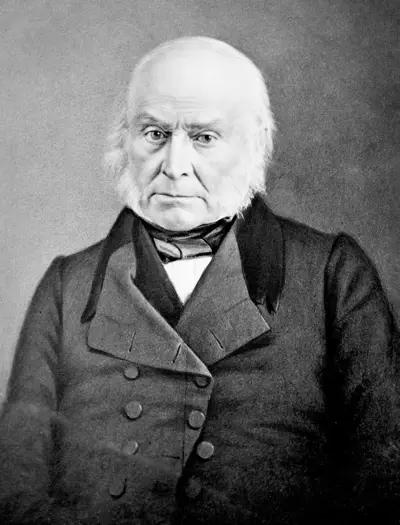
John Quincy Adams was an American statesman, diplomat, lawyer, and diarist who served as the sixth president of the United States, from 1825 to 1829. He previously served as the eighth United States Secretary of State from 1817 to 1825. During his long diplomatic and political career, Adams also served as an ambassador, and as a member of the United States Senate and House of Representatives representing Massachusetts. He was the eldest son of John Adams, who served as the second U.S. president from 1797 to 1801, and First Lady Abigail Adams. Initially a Federalist like his father, he won election to the presidency as a member of the Democratic-Republican Party, and in the mid-1830s became affiliated with the Whig Party.
