Paul Farmer Quotes
Technological innovations [in public health] that come from basic science have to be transformed from discovery to delivery, and that gap is huge.
The “gap” is different in different fields. Public health has a particularly large gap while laser app;ications have a much smaller one.
Paul Farmer, Physician and International Public Health Expert, Presentation, 6th & I Street Historic Synagogue, Washington DC, June 16, 2013
Sourced by: Eigen's Political and Historical Quotations


This is why the American Government has played such a major role in most of the great technologies in American History. Interchangable Parts (A federal contract with Eli Whitney), Canal Construction (New York State built the Erie Canal), the Railroad (federal government gave hugh tracts of land to build the rail lines to the West), the Telegraph (No one would use it until the government financed the experiment to prove it by creating a line between Baltimore and Washington), AC Electricity, there the city of Rochester NY hired Tessler and Westinghouse to Demonstrate Generating Electricity at Niagra Falls and transmitting it over 20 miles which Edison’s Direct Current could not do), immunization (the Army Medical Corps gave the first grants to universities to develop the science of vaccines and immunization, the computer (in WWII the U. S. financed the development of computers sent to England to implement Turing’s breaking of the German “unbreakable” code), atiomic energy (the Manhattan Project—the largest scientific endeavor the world has known), the Internet (Developed with long term research funds for DARPA the future technology research arm of the Defense Department. American investors and businesspeople took each of these and developed them but the initial steps, when no capitalist dared risk on such basic and futureistic efforts were taken by American Government which probably could never have developed these technologies but the private sector could not do it with government in the role Moritz herein describes.


He was observing that from a public policy point of view, it is very difficult to target research funds on projects that will have practical innovations because so many come from basic research or research in an entirely different field of science.


Babbage anticipated the digital era when a small number of computer programmers develop a powerful program that can be used by millions of people who have no skill at programming.

Many of his greatest ideas were not sufficiently appreciated by many other scientists nor the businessmen who funded scientific projects then. Tesla was one of the great American immigrant scientists. He found in America the kind of intellectual and operational freedom that did not exist in the rigid, monarch-controlled, Austro-Hungarian Empire. He developed patents and techniques that formed the technological bases of radio, telephone long distance, TV, cell phones, Wi Fi, just to name a few. Most important he was Thomas Edison’s great nemesis. Edison invented DC electric generators that could power factories or entire streets in a neighborhood. Tesler invented and developed AC electrical technology which could power entire cities and he could move electricity over long distances which Edison could not. Tesler was one of the first scientists to conceive of and try to implement “Big Science” where there were huge capital investments to develop machines and systems to do what had never been done before—philosophically like the CERN Hadron Collider. Tesler even convinced a large corporation to finance the construction of a massive building and tower so he could experiment with the wireless transmission of electricity. However, as the industrial democracies have learned, Big Science can only be funded by governments and it often takes sever working in consort to afford the huge investment that is required. In Tesler’s era, the federal and state governments did not fund scientific research so his work was not only technically ahead of his time but also conceptually. He anticipated most of the problems and need for a national power grid that was challenging America even at the beginning of the 21st century.


Often, excellent technical solutions are developed but they fail to be implemented in a foreign country—sometimes even in a modern industrialized democracy—because of customs, norms, superstition, religion. Vaccines often receive human opposition—even in the United States.

Most environmentalists limit the vision of their solutions to using less of our precious natural resources which is very important but just as important and perhaps more so in the long run is increasing the supply of these resources. Food is an example. The major reason that there is no serious food shortage world-wide is that we have increased the productivity of agriculture requiring less labor, less water, less fertilizer, less land, and less dependency on weather. Distribution has also improved, but there is no very good way of distributing something for which there is a great shortage.

Some scientists would use this as an example of what scientific research is really like; others would argue that Ballard, however great as a field scientists and explorer, was a poor basic scientist and theoretician. He tends to work in the softer side of his science. This would be a very unusual occurrence for an experimental physicist or a molecular biologist.


This quotation became the mantra of the MIT Media Lab's Professor Hugh Herr and others whose total efforts are spend inventing things for the future.


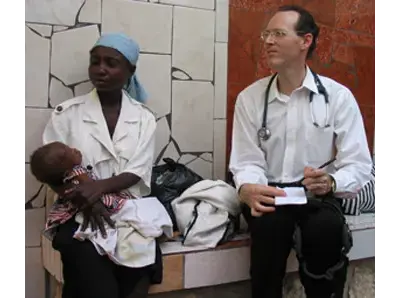
Paul Edward Farmer is an American medical anthropologist and physician. Farmer holds an MD and PhD from Harvard University, where he is the Kolokotrones University Professor and the chair of the Department of Global Health and Social Medicine at Harvard Medical School. He is co-founder and chief strategist of Partners In Health (PIH), an international non-profit organization that since 1987 has provided direct health care services and undertaken research and advocacy activities on behalf of those who are sick and living in poverty. He is professor of medicine and chief of the Division of Global Health Equity at Brigham and Women’s Hospital.
