Homer Quotes
Strife and Confusion joined the fight, along with cruel Death, who seized one wounded man while still alive and then another man without a wound, while pulling the feet of one more corpse out from the fight. The clothes Death wore around her shoulders were dyed red with human blood.
Homer. The Iliad. Translated by Ian Johnston, Richer Resources Publications, 2006, p. 384.

Prior to whites settling in America, various Indian tribes had a long history of fierce fighting for control of Kentucky. The Transylvania Land company negotiated for the “rights” to Kentucky. Dragging Canoe, who opposed the treaty, argued that the land had a bad history and would be very difficult to settle. Poet Theodore O’Hara described Kentuckians as “Sons of the Dark and Bloody Ground” in his poem, The Bivouac of the Dead.


John Mason led a force of 90 Pilgrims and 70 Mohegan Allies quietly surrounded the Pequot village at Mystic. Then they fired their guns into the village and charged the Pequot houses, setting them on fire and killing all those who tried to escape. Over 400 Pequot were killed. The Mohegan allies were so shocked at the carnage that they shouted, “Stop! Stop! It is naught, it is naught, because it is too furious, and slays too many men.” Prior to the massacre of Mystic Village, there had been many battles and villages destroyed, but this marked the first time that entire populations of men, women and children were exterminated in the English Colonization. After Mystic village both whites and Indians participated in terrible massacres inflicted on each other. This was not the first massacre in America as the Spanish in the South and West commonly used the tactic.


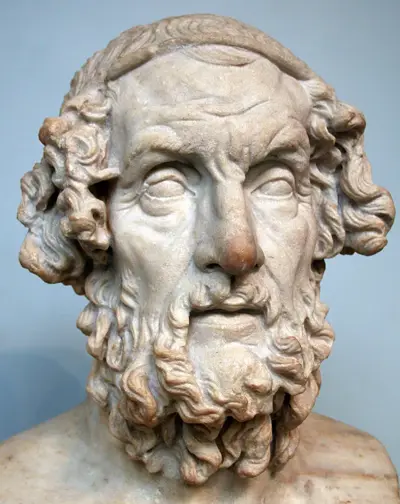
Homer (/ˈhoʊmər/; Ancient Greek: Ὅμηρος [hómɛːros], Hómēros) was the presumed author of the Iliad and the Odyssey, two epic poems that are the foundational works of ancient Greek literature. The Iliad is set during the Trojan War, the ten-year siege of the city of Troy by a coalition of Greek kingdoms. It focuses on a quarrel between King Agamemnon and the warrior Achilles lasting a few weeks during the last year of the war. The Odyssey focuses on the ten-year journey home of Odysseus, king of Ithaca, after the fall of Troy. Many accounts of Homer's life circulated in classical antiquity, the most widespread being that he was a blind bard from Ionia, a region of central coastal Anatolia in present-day Turkey. Modern scholars consider these accounts legendary.
