Literary Digest Quotes
Some might have liked us more if we had intervened less ... some might have disliked us less if we had intervened more, but ... having concluded that we intended to intervene no more and no less than we actually did, nobody had any use for us at all.
Towards the end of World War I, an expedition of 7,000 American troops was sent to Siberia with vague and confused instructions regarding the their role in the conflict between the "white" and "red" Russians:
Literary Digest, Editorial, September 6, 1919
Sourced by: Eigen's Political and Historical Quotations


After the World War I armistice there were 7,000 American troops remaining in Russian Siberia to the chagrin of the Secretary of War who wanted them removed. One reason given for their presence was to "protect our relief efforts there:"


He had been in exile in Europe and arrived in Russia and observed the chaos, poverty, and the heavy hand of the Lenin’s Communist Party. When the Communist leaders were criticized for their harsh, dictatorial methods, many would use the cliché that if you want to make an omlette, you have to break some eggs.

Chamberlain’s policy was to appease Hitler and Germany to avoid war. Although he did not see Czechoslavkia as a critical British national interest and claimed he had secured peace {585941} , the reality was that he gave Germany room to start its aggression which would engulf all of Europe and much of the world. The British became the only bulwark against Hitler until the Russians stopped the Germans and America entered the war.

Mexico was having a dispute with Guatemala and threatened invasion of that country. Blaine warned Mexico against it.

In 1917 the fledgling Russian revolutionary government was threatened by Germany. English and French aid was a possibility, but many Russians were opposed to taking aid from capitalists: Vladimir Lenin

At the end of WWII there was much tension between Russia and the Anglo-American alliance. This plan was developed but never implemented. See {613195} for Prime Minister Winston Churchill’s description of the invasion idea.


Holland was then a Republic and federation of the separate states. Each elected representatives to the ruling legislature, however, many states had not been pleased that their representatives did not reflect the desires and public opinion in the individual states and in some cases took bribes to vote in favor of special interests. The Dutch did NOT want their representatives to use their own judgment but wanted them to seek and follow the instructions of the legislatures of each state.

He was announcing the arrest of an agent of the Iranian Government who was plotting to assassinate the Saudi Arabian Ambassador to the United States.

Tito often did not support Soviet policies, but in the case of the Hungarian Revolution he did. He saw Hungary was split into pro and anti Communist factions in the midst of the Cold war. He and the Russians feared that if the Hungarians were allowed to settle their own dispute, there would be a protracted civil war with neither side strong enough to win rapidly. If this happened, the Russians were treaty bound to provide arms and other assistance to the Communist Hungarian government. And if they did so, it was very likely that NATO and the United States would supply similar assistance to the Hungarian Revolutionaries. The result would surely involve enormous loss of Hungarian lives on both sides, and the clear risk of an East West clash that would lead to a World War that might be nuclear. Russian troops and tanks rolled into Hungary and the conflict was over in a few days with very little loss of life. Therefore, even though Hungary lost its independence and freedoms, it was a necessary evil in Tito’s view.


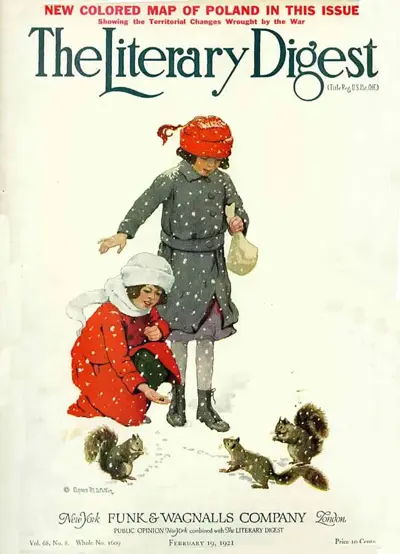
The Literary Digest was an influential American general interest weekly magazine published by Funk & Wagnalls. Founded by Isaac Kaufmann Funk in 1890, it eventually merged with two similar weekly magazines, Public Opinion and Current Opinion.
