Wilhelm II, German Emperor Quotes
So the Chinese have at last given us the grounds and the ‘incident’ which we have so long desired.
The Germans had been looking for an excuse to send military troops into China to establish German zones of control in China. The Germans were not alone in having areas of control and influence in China. England, France, Italy, Holland, Japan and the United States all were vying to control trade on parts of China. The Germans, under Wilhelm, were just a little more heavy handed and gross than the other powers.
Wilhelm II, 1859-1941, Emperor of Germany & King of Prussia, Statement after two German missionaries had been murdered in China, ~1896
Sourced by: Eigen's Political and Historical Quotations

Response when German Troops were occupying a part of China. See {641706}.


Every major Western power and Japan were looking to control parts of China for their own mercantile advantage. The Emperor, her adopted son, had stated that under no circumstances would the Chinese fight, but Cixi issued this decree, in effect, overruling the Emperor—a remarkable occurrence.


Instructing the navy not to act precipitously during the Cuban missile crisis:

That was an ironic statement. Shortly thereafter we invaded Mexico, occupied the country, pressured it into “selling us much of what is now the Southwest of the United States, and finally left.


The report was from Heinrich von Tschirschky, the German ambassador to Austria-Hungary. He recommended that Germany persuade Austria-Hungary to not attack Serbia, not realizing the German leaders had already planned a war with Russia and saw the issues between the Austro-Hungarian Empire and Serbia was a good excuse to implement their war plans (see {642092}).


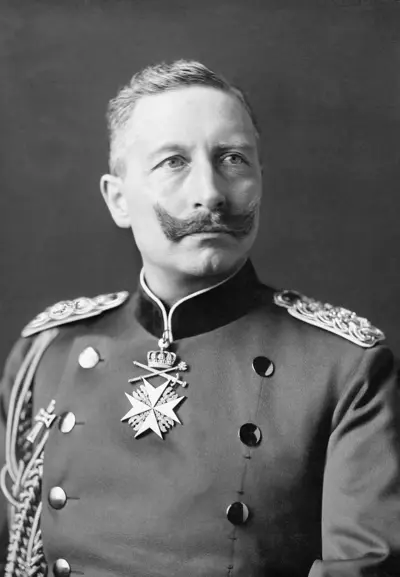
- Born: January 27, 1859
- Died: June 4, 1941
- Nationality: German
- Profession: Statesman
Wilhelm II, anglicised as William II, was the last German Emperor (Kaiser) and King of Prussia, reigning from 15 June 1888 until his abdication on 9 November 1918. Despite strengthening Germany's position as a great power by building a blue-water navy and promoting scientific innovation, his tactless public statements greatly antagonized the international community and his foreign policy was seen by many as one of the causes for the outbreak of World War I. When the German war effort collapsed after a series of crushing defeats on the Western Front in 1918, he was forced to abdicate, thereby bringing an end to the three-hundred-year rule of the House of Hohenzollern.
