Sir Frederick Pollock, 3rd Baronet Quotes
So far I go with the Socialists as to think it a pretty general rule that, where monopoly is necessary, it is better in public hands.
Howe, Mark DeWolfe, ed. Holmes-Pollock Letters: The Correspondence of Mr. Justice Holmes and Sir Frederick Pollock, 1874-1932. Harvard University Press, 1941.

1st Viscount Snowden. Nationalization is when a nation or state determines that certain industries of areas of the economy should be reserved for the government to operate. Private companies, if they have been operating a nationalized industry losse their rights to continue in that business and may even lose their physica assets in which case th form is supposed to be paid a fair price. In 21st century America we have very few nationalized industries. One of these is the manufacture of nuclear weapons. Communist counties have many if not most of the economy nationalized. From the 19th century socialism has evolved from a belief that most people will best be served by nationalization of most of th major economic functions. However, over time this did not meet Socialism’s other objectives and nationalism became less popular with socialists. Snowden, a leading socialist, wanted to get rid of the concept entirely, and today there are very few situations where there are calls for nationalis. Even the few remaining communist nations are privatizing (the opposite of nationalizing) some of their economy.


The founder was Charles E. Coughlin, 1891-1979, a demagogic Catholic Priest who drafted the principles and invited others to join him. Hundreds of thousands did in this organization which began in idealism, and ended in scandal and hate mongering, so much so that Father Coughlin was ordered off the radio and out of politics by the Catholic Church. The National Union in 1936 had morphed into the Union Party which ran Presidential candidates in the 1936 election. The Coughlin and the Union were a mixture of Fascist and Socialist principles. The prohibition of private ownership of banks and utilities was one of the radical socialist notions.

The first part of this quotation has defined the attitude of most Americans towards private enterprise and government since then. The second part of the quotation—the undesirability of public ownership of railroads has given way to the modern problem that no passenger railroad can be operated profitably by anyone—private or public. So Roosevelt’s “far-reaching disaster” was finally complete with the Federal Government taking over responsibility for Amtrack.

Ironically the far right wing Fascists and the far left wing Communists agreed on this point: nationalization.


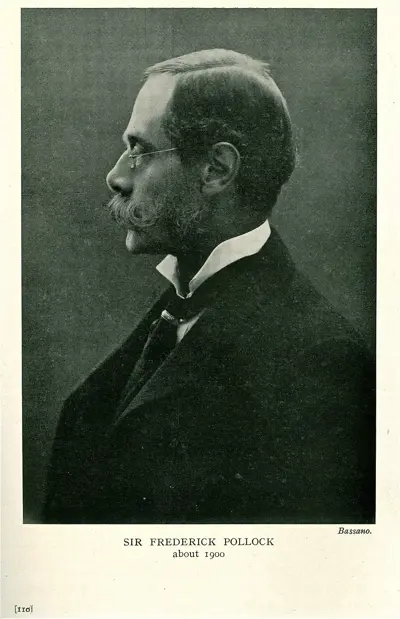
Sir Frederick Pollock, 3rd Baronet PC, FBA was an English jurist best known for his History of English Law before the Time of Edward I, written with F.W. Maitland, and his lifelong correspondence with US Supreme Court Justice Oliver Wendell Holmes. He was a Cambridge Apostle.
