John Marshall Quotes
Protection does not imply the destruction of the protected
Jackson was the only American President who disobeyed a Supreme Court Decision. See {635653}. In doing this, he killed tens of thousands of Indians, allowed the Southern Whites to steal most of the Cherokee land. His Indian Removal contrary to the Supreme Court decision, was the worst case of ethnic cleansing in the history of the United States.
John Marshall, 1755-1835, Chief Justice of the U. S. Supreme Court, U. S. Congressman (Federalist, VA), U. S. Secretary of War, U. S. Secretary of State, Criticizing President Andrew Jackson’s decision to ignore the Supreme Court decision and remove the Cherokee by force from their own land guaranteed by treaty, 1831, Quoted in Smithsonian, March 2011
Sourced by: Eigen's Political and Historical Quotations

Jackson refused to obey this decision, He was the only American President who disobeyed a Supreme Court Decision. In doing this, he killed tens of thousands of Indians, allowed the Southern Whites to steal most of the Cherokee land. His Indian Removal, contrary to this Supreme Court decision, was the worst case of ethnic cleansing in the history of the United States.


The Supreme Court had ruled that Georgia and the other Southern States and the Federal Government could not remove the Cherokee from their land. However, President Jackson was going to force them off their very well developed farms and estates despite the Supreme Court ruling. Ridge and a few others were bribed by the whites to get a self- appointed group of Cherokee to “sell” their land in the South East to white syndicates, Ridge and his fellows then were given the choicest land in Oklahoma which was far inferior to the land that they had left.


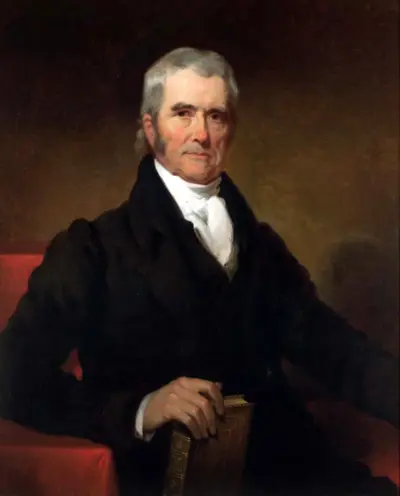
- Born: September 24, 1755
- Died: July 6, 1835
- Nationality: American
- Profession: Judge
John Marshall was an American politician and lawyer who served as the fourth Chief Justice of the United States from 1801 to 1835. Marshall remains the longest-serving chief justice and fourth-longest serving justice in Supreme Court history, and he is widely regarded as one of the most influential justices to ever sit on the Supreme Court. Prior to joining the Supreme Court (and for one month simultaneous to his tenure as Chief Justice), Marshall served as the United States Secretary of State under President John Adams.
