Tony Abbott Quotes
Prima facie, every estate, whether given by will or otherwise, is supposed to be beneficial to the party to whom it is so given.


For similar views see Franklin Delano Roosevelt, Potter Stewart and the National Union for Social Justice.

At the time, in many states married women could not control their own inheritance, could not sign a contract, owned no part of a family business that a women might have founded and worked in her entire life, could not be an executor of a will—even if it were her husband’s.


This quotation illustrates how the power and mechanism of an established church operated to control ideas and maintain theological monopoly. In this case, no one could sell or rent any facility in the city to a cleric or church of any kind or persuasion without first having the approval of the Bishop who had theological control of that territory. Even Catholic scholars could not rent a room in the city unless their scholarship met with the Bishop’s approval. This was history with which the American Founding were very familiar, and wanted to avoid by adopting the 1st Amendment.

Abolition was an issue from the first Congress onward. By the 1850s there was a major, and in the view of the Southern Slavery enthusiasts, incessant political, journalistic, and intellectual attacks on slavery. The latter two really affected public opinion and opposition to slavery grew in intellectual and educated circles. This document was an example of the literature of the time where the attack on slavery was made by simply explaining the “logic and facts” of the existing laws of the slave states. Once exposed in their entirety, the horror and immorality of the institution was supplemented by the intellectual absurdity and logical fallacies of the pro slavery forces. Note the swipe Goodell takes at Congress. This kind of public criticism made it harder and harder for the Northern Congressmen to “go along” with the South on the slavery issue, and the next decade of increased polarization on slavery culminated in the Civil War. It was not the Southern representatives who changed, but consciousness raising and public opinion changed the Northern perspective and the voting of the Northerners to oppose slavery. Earlier “compromises” became no longer morally or politically acceptable.

Since a slave was not a person, he/she could not accept any gifts or own any property. They were themselves property. The Greeks, the Romans, the ancient Germans, the Poles, with the Portuguese, the Spanish and the French had provided, both by law and by custom, for the possession of property by the slave, which could, not be seized by his master. This is another sense in which American slavery was even worse than most slavery had been.

This was an effort to keep Asian immigrants—who were ineligible for citizenship under the racist Federal laws though the 1930s from competing with American farmers. Many of the Western states also had laws or Constitutions prohibiting Asians to not only own land but also forbidding them from even having long tern leases on land. The Japanese in California were so successful that in the 1920s that state passed a version of Asian land ownership prohibition. The Supreme Court at the time actually ruled that this kind of discrimination was legal. A French alien could own land but not a Japanese. The loophole however was that many Japanese short term tenant farmers who had saved enough money to buy land, had children who were born in the United State and hence where citizens. The land was purchased by the citizen children. California however went so far as to make it illegal for a Japanese person to be a guardian of his minor children if the children were born in the United States, but that law was struck down as unconstitutional by the Supreme Court.


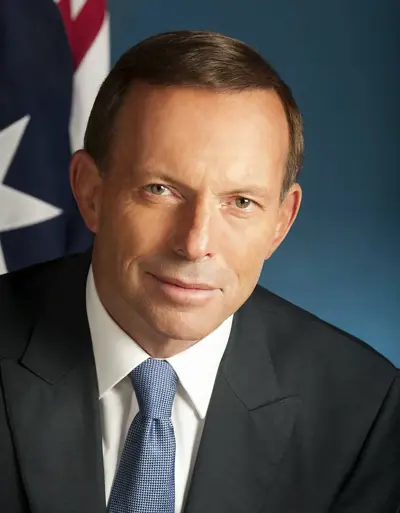
Anthony John Abbott AC is a former Australian politician who served as the 28th Prime Minister of Australia from 2013 to 2015 and leader of the Liberal Party from 2009 to 2015. He served as Leader of the Opposition from 2009 to 2013, and as Member of Parliament (MP) for Warringah from 1994 to 2019. He is currently an adviser to the British government's Board of Trade.
