Robert Jervis Quotes
President’s usually do not want to hear an intelligence analyst’s doubts, preferring confidence (even when unwarranted) in one policy option.
Robert Jervis, Political Scientist, “Why Intelligence and Policy Makers Clash”, Political Science Quarterly, Summer 2010
Sourced by: Eigen's Political and Historical Quotations


The Central Intelligence Agency had a hand in the assassination having smuggled in the weapons. However, the government takeover plan did not go as expected and there was no clear alternative plan to go to.
His concern was well placed. For over half a century thereafter, the tail did wag the dog, and while there have been many successful covert operations, the risk and current pressure siphoned off talent and management attention from intelligence—the Central Intelligence Agency’s primary job.
This was an indirect criticism of Condoleezza Rice, the National Security Advisor to George W, Bush for not taking a role that Mazarr and many others believe she should have. On the other hand, President Bush selected her precisely because she shared his values and instincts. Perhaps, Bush should have selected and advisor who held a DIFFERENT view and perspective from himself. This quotation reveals the classic dilemma of political appointments of key advisors and cabinet members. Bush and Ronald Reagan tended to select advisors who agreed with them in philosophy and politics. FDR and Obama, followed the Lincoln tradition and appointed many advisors who were not intellectual clones of their own views and values.

even though in this case the objective The State Department, the Defense Department and most important President Kennedy had decided to get rid of Diem. Most of the Central Intelligence Agency thought that this was a very unwise policy, because Diem was a known risk, and the people who would replace him and their talents and policies were unknown. The negatives of Diem—the facts that he, a Christian, was persecuting the majority Buddhists, was totally corrupt, and not a very good leader was less distressful to the CIA than to the President and the other agencies as the intelligence agency frequently not only tolerated “offensive” allies, but actually employed them including war criminals. Another importance of this quotation is that it shows that it was by no means certain that the CIA would always follow the orders of the President and the government policy makers. Colby, who was not the agency director at that time but was the head of the South East Bureau, was one high level official who argued that the policies should always be followed even if they were unwise or foolish. Another importance of this quotation is that it illustrate a common error that administrations are frequently forced to make: making a policy decision to eliminate a problem while not having much of an idea of what the alternative or consequence would be when the policy is implemented. The Syrian Civil War in 2013 was a good example. The Government side appeared to have used Chemical Warfare on Civilians and public opinion demanded that we do something. However, having a no-fly zone or any of the alternatives to prevent (punish) the government for the Chemical Warfare would strengthen the rebel side which was made up of numerous factions—some of which were known Islamic fundamentalist terrorists and jihadists. If the balance of power were tipped toward the rebels, the consequence for the American national interests were unknown—just as the consequence of ousting Diem was unknown and turned out to also be bad and was probably worse.


The CIA did not have a long tradition. It was created after WWII when the OSS was are espionage organization had been disbanded In the early days of the Cold War, the CIA went rogue and engaged in covert activities without the knowledge and approval of the President and his cabinet. General Maxwell Taylor conducted a thorough investigation and the agency was brought under control. There hav been several more incidents since then and every few years there have been additional scandals of unauthorized operations which were harmful to American interests and values. In a democracy it is always hard to control a secret organization. Actually, at the beginning of WWII, we had almost no espionage capability and President Roosevelt had a series of friends who provided him with intelligence until William Donavan had time to establish the OSS which did such a wonderful job.


Precursor to CIA. Stephenson was the British leading intelligence and espionage expert who served as the Intelligence Advisor to Winston Churchill in WWII. He was very forthcoming in teaching Donavan and the new OSS much of what they learned about spy-craft and intelligence operations.


He was very critical of Arraham Lincoln even though he was a Republican. Many percieved that Lincoln's administration could not get anything done. Lincoln might have lost the 1864 campaign but for the great victory that General Sherman's troops had in taking Atlanta. This changed a lot of mionds about Lincoln's War strategy. Actually, in the first 2 years of the Civil War, Lincoln could not get his generals to fight his preferred kind of war until he appointed Grant who brought Sherman to high command.

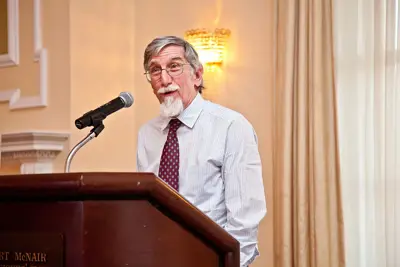
Robert Jervis (born 1940) is an American political scientist who is the Adlai E. Stevenson Professor of International Politics in the Department of Political Science at Columbia University, and is a member of the Arnold A. Saltzman Institute of War and Peace Studies in the School of International and Public Affairs. He has been a member of the faculty since 1980. Jervis was the recipient of the 1990 University of Louisville Grawemeyer Award for Ideas Improving World Order. Jervis is co-editor of the Cornell Studies in Security Affairs, a series published by Cornell University Press, and the member of numerous editorial review boards for scholarly journals. According to the Open Syllabus Project, Jervis is the fourth most-frequently cited author on college syllabi for political science courses.
