Saint Augustine Quotes
Poltinus the Platonist proves by means of the blossoms and leaves that from the Supreme God, whose beauty is invisible and ineffable, Providence reaches down to the things of earth here below. He points out that these frail and mortal objects could not be endowed with a beauty so immaculate and so exquisitely wrought, did they not issue from the Divinity which endlessly prevades with its invisible and unchanging beauty all things.
Augustine, Saint. The City of God. Translated by Marcus Dods, T. & T. Clark, 1871, p. 401.


What is particularly interesting about this quotation is the date. As late as 1932, a governor of a major state, was declaring a State holiday for a particular religion, and in his official capacity was recommending fasting and paryer within a Christian context. Although the Proclamation violated the First Amendment, at the time few people would make the effort to go to court to challenge what had been a long tradition in America of declaring Christian Holidays official and the keeping of the Sabbath with criminal penalties for those who did not. However, it took time, effort and money to challenge these practices in court, and the majority community did not treat those people well socially who challenged custom as unconstitutional even when the courts agreed and restrained the practice. Even into the 21st century there were still a few legal battles about prayer in schools and promulgating Biblical passages in public buildings. From the late 1800s to the latter part of the 20th century, it was the Democrats who attracted most religious Americans while the Republicans were the party who advocated a non-traditional but Constitutional approach to religion. See {623322}

The death of President William Henry Harrison just one month after his inauguration was:

Of all presidential statements about a Supreme Being, this is probably the one that argues for the greatest dependency on such. It is not quoted very often because Pierce was one of our weaker Presidents.


While most American leaders in 1776 advocated separation of church and state, others did not. There probably has been no better statement for religion in government than this one. Essentially, this view has been held by orthodox Christians, Jews, Muslims and has been at the heart of every theocracy such as Iran.

At the time, it was very difficult for people who had been taught all their lives that God was directly responsible for the creation to accept the notion of evolution. At the time, there was not the overwhelming evidence proving Darwin’s theory that we have today. Nor did theologians realize that evolution and Darwinism were not inconsistent with the concept of a creator and supreme being. Nonetheless, there are still those who, like Agassiz, reject evolution and insist that the Biblical version of creation is literally true. See {586990}. Then there are people who have come up with the concept of Intelligent Design which originated with Agassiz though he never called it that. Most religious people today, in contrast, see no conflict in natural selection as described by Darwin and later proven, and the concept of God. They see the Biblical creation as metaphorical and natural selection as the product of an omniscient supreme being.
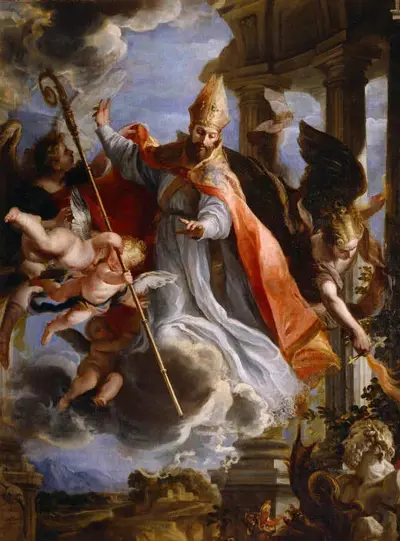
Augustine of Hippo, also known as Saint Augustine, was a theologian, philosopher, and the bishop of Hippo Regius in Numidia, Roman North Africa. His writings influenced the development of Western philosophy and Western Christianity, and he is viewed as one of the most important Church Fathers of the Latin Church in the Patristic Period. His many important works include The City of God, On Christian Doctrine, and Confessions.
