Niccolo Machiavelli Quotes
People should either be caressed or crushed. If you do them minor damage they will get their revenge; but if you cripple them there is nothing they can do. If you need to injure someone, do it in such a way that you do not have to fear their vengeance.
Machiavelli, Niccolò. The Prince. Translated by George Bull, Penguin Books, 2003, p. 8.


Although politics can get very rough, Rove took revenge for disagreement or what he perceived as disloyalty to an extreme that was new to the American experience. In one case, to punish an ex ambassador who had made public statements disagreeing with George W. Bush’s policy, Rove leaked the fact that the ambassador’s wife was a covert CIA agent, thus blowing her cover, ending her career, and endangering her life and the lives of some of her contacts. Rove pretended to be a devoted Christian for political image, his behavior towards opponents was far from Christian and his language as can be seen by this quote was not consonant with a religious person’s behavior.


This proverb only makes sense in the light of understanding the Arab concept of revenge—“blood.” In a rural desert environment where little can be expected of government, the Arabs have developed a law enforcement and peace keeping mechanism which while primitive from modern standards, nevertheless worked to some degree. It is that revenge—“blood” is a moral necessity and obligation of all people, and revenge is not limited by time or to the individuals involved in the first incidence. The immediate family are the first to exact revenge, but the extended family follows and often the entire clan. Sometimes revenge is tribal or even national. Anyone who fails to revenge a member in his group is not only a disgrace, but is a clear and present danger to the group because then they can be attacked with impunity. So revenge is a strong obligation of the group members and blood must be paid with blood no matter how many generations it may take. The only thing that keeps me and my family safe, is the surety what whosoever kills one of us will themselves be killed or if they die a natural death we will take revenge on one of the evildoers relatives and no one is exempt. Crime must never pay!


This sura on retaliation for murder is behind the Saudi Arabian law which allows the male relative of a murder victim to personally wield the sword in the beheading of the murderer.
The right of vengeance was written into the first book of law for the Muslims. It was a very strong part of the culture long before Muhammad, amongst all the tribes. Before there were organized law enforcement agencies, family and tribal vengeance was the basic mechanism of law enforcement. Unfortunately for many cultures and people, it still is a legitimate method of law enforcement—even in many of the modern industrial democracies.

This was one of Jackson’s official major justifications for his controversial Indian Removal policy. The logic was that since there had been some Indian raids on whites with whites being killed, the whites had a right to retaliate and a good way of doing that was by taking their land and removing them to lands far away. He saw a Christian virtue to the policy as they whites did not raid and kill the Indians. The “logic” such as it was, of course, ignored the fact that there had been white raids and massacres of Indians as well, but in both cases, they were done by a small minority of the Indians and Whites, Jackson’s view was that all Indians should be held responsible for the act of some violent Native Americans. However Jackson had used this guilt generalization before and even used the term “retaliatory vengeance” when he vowed revenge on the British for his treatment as a Prisoner of War in the American Revolution — See Quotation 621975.

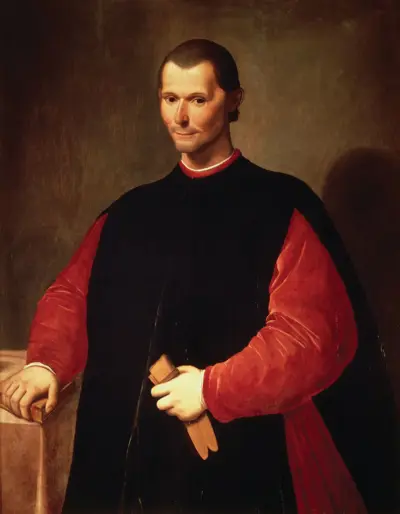
Niccolò di Bernardo dei Machiavelli was an Italian Renaissance diplomat, philosopher and writer, best known for The Prince (Il Principe), written in 1513. He has often been called the father of modern political philosophy and political science.
