Noam Chomsky Quotes
Over the years, there have been a series of concepts developed to justify the use of force in international affairs for a long period. It was possible to justify it on the pretext, which usually turned out to have very little substance, that the U.S. was defending itself against the communist menace. By the 1980s, that was wearing pretty thin.
Chomsky, Noam. Hegemony or Survival: America's Quest for Global Dominance. Metropolitan Books, 2003, p. 15.


This quotation illustrates the derogatory and disrespectful attitude that many high level American officials then had towards Arab leaders. No one objected to or reprimanded Symmes for his use of the word “mongrels”. And he was the State Departments leading expert on the Middle East and Arab Cultures. In the photo, Symmes is the gentlemen on the right.


The occasion was the visit to Washington of French Minister M. Jean Letourneau. The French were fighting the communists in Vietnam and the U. S., not yet in the fight, promised material and political aid, but no military participation. It was almost a decade later that America sent its first military personnel to Vietnam. The West was persuaded that the French could handle the situation. When they were defeated, America and Britain assumed that it was the notorious military incompetence of the French that accounted for the situation rather than the competence and commitment of the Vietnamese Communists and their support of the majority of the people.

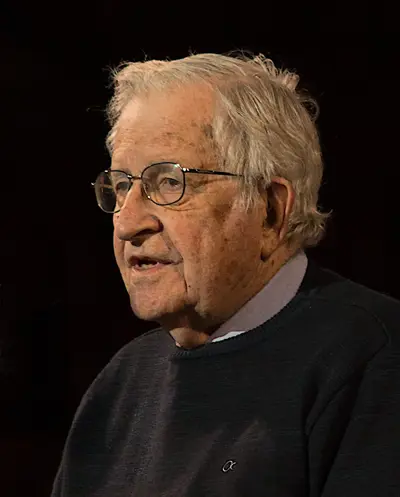
Avram Noam Chomsky is an American linguist, philosopher, cognitive scientist, historian, social critic, and political activist. Sometimes called "the father of modern linguistics", Chomsky is also a major figure in analytic philosophy and one of the founders of the field of cognitive science. He is Laureate Professor of Linguistics at the University of Arizona and Institute Professor Emeritus at the Massachusetts Institute of Technology (MIT), and is the author of more than 150 books on topics such as linguistics, war, politics, and mass media. Ideologically, he aligns with anarcho-syndicalism and libertarian socialism.
