Hubert Humphrey Quotes
Our wars were not fought for the glory of war, but for freedom.
Hubert Horatio Humphrey, 1911-1978, Vice President of the United States (Democrat), U.S. Senator (Democrat, MN), Address, 1960 Democratic Convention
Sourced by: Eigen's Political and Historical Quotations

Trumbo was morally opposed to war. He also refused to name Hollywood communists to Congressional Committees during the Red Scare. He was then blacklisted from his occupation, screen writing.


Patton, one of the world’s best fighting general was somewhat mentally unbalanced and unlike almost all senior officers who are successful commanders but see war as an unpleasant, brutal necessity, Patton loved war and the fighting part of it. His non battlefield behavior was so erratic and atrocious that Eisenhower and his other superiors almost fired him on several occasions. He died in an automobile crash shortly after the German surrender, so the dilemma of what to do with Patton in peacetime was resolved.


See Noah Webster and Timothy Pickering for similar positions. The War of 1812 was very unpopular with the New England states. They had the most developed trade with England and were economically injured by the curtailment of that trade. The citizens of Essex wanted to give the State Legislature the most possible moral and political power to negotiate an end to the war.

Reports were widespread that General Grant was an alcoholic and was frequently drunk in the field. Lincoln was under pressure to relieve Grant of his command in the West. To a Pennsylvania politician he explained:

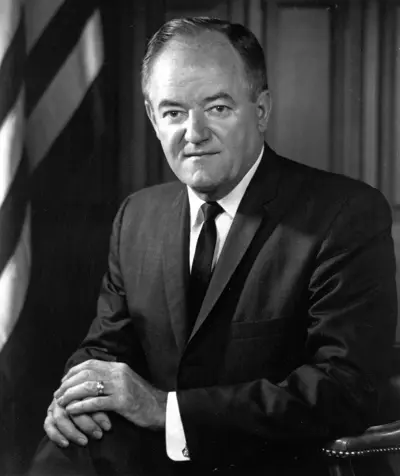
Hubert Horatio Humphrey Jr. was an American politician who served as the 38th vice president of the United States from 1965 to 1969. He twice served in the United States Senate, representing Minnesota from 1949 to 1964 and 1971 to 1978. As a senator he was a major leader of Modern liberalism in the United States. As President Lyndon Johnson's vice president, he supported the controversial Vietnam War. An intensely divided Democratic Party nominated him in the 1968 presidential election. He lost a close race to Republican nominee Richard Nixon.
