John Adams Quotes
Our pure, virtuous public-spirited, federative republic will last forever, govern the globe and introduce the perfection of man.
Adams, always accused by Jefferson of having English Monarchist Tendencies, was the only Founding Father who ever advocated an American role of “governing the globe.” When Adams assumed the Presidency, he adopted monarchist titles, instituted the Alien & Sedition Act, and convinced most Americans and their representatives that Jefferson had been right about Adams who lost after his first term to Jefferson. To this day many Americans agree with the last part of Adams statement that we should export the American concept of democracy or what Adams referred to as the “perfection of man.” Adams hated the English and the English King, but was not necessarily opposed to many of the attributes of monarchy.
John Adams, 1735-1826, 2nd President of the United States (Federalist, MA), Statement to Thomas Jefferson in 1813, Quoted by Adam Zamoyski in “Holy Madness: Romantics, Patriots, and Revolutionaries, 1776-1781”
Sourced by: Eigen's Political and Historical Quotations


The government relationship to people phrase, although probably Lincoln's most famous, was not totally original. John Adams came close in a 1774 proclamation. As did John Marshall in his McCulloch v. Maryland decision. Daniel Webster's Speech on Foot's Resolution was very close. as was Theodore Parker in 1850 {629578}. There was also Thomas Cooper in 1795. But the earliest appears to be John Wycliffe in 1382 {567292}. It is not known with which of these Lincoln was familiar.


Cochrane became the Admiral in Chief of 2 Different South American Nations—Peru and Brazil—fighting for their independence. Incredibly enough, he was able to form idealistic freedom fighters with no naval experience into navies which defeated both the Spanish and Portuguese fleets at a time when those countries had world class navies. His achievements on behalf of the South Americans are often regarded as the most remarkable naval achievements in history.


This Proclamation was issued upon arrival of the British occupying imperial army in present day Iraq. The English policy makers like the Bush administration almost a century later were expecting a more welcoming reaction. See {585250}.

The words “extensive empire” imply that Jefferson who doubled the size of the United States with the Louisiana Purchase was thinking of a nation that spanned the continent and was happy with the fact that the Constitution did not obstruct the addition of additional states and territories.


President Benjamin Harrison and Congress proclaimed that October 31, 1892 be a national celebration of the 400th Anniversary of Columbus landing in America. Bellamy represented a juvenile weekly publication and was named chairman of the committee to conduct the celebration. A first draft of the pledge was written by James B. Upham, a staff member of the publication. The words "under God" were added in 1952 by an Act of Congress. The original had “to my flag.” The pledge was first used publicly at the Chicago World’s Fair on October 21, 1892. It was not endorsed by Congress until 1942. It is officially recognized as law in 36 United State Code 172.


The organization sent 2,100 volunteers to fight for South American independence from Spain.

Harding was arguing for party government. He may or may not have been right, but he was one of the weaker administers that held the American presidency. In addition he was not a particularly hard worker, and was more than willing to share any burdens.


A few weeks after the Japanese sneak attack on Pearl Harbor, Japan invaded the Philippines and occupied the country. They thought that because of the original American occupation and some American war crimes in the American Philippines War, the people would welcome Japan, thinking that Japan had freed them from the United States domination. However, by that time, most of the Filipinos had become pro American and despite many posters like this one, the Japanese were hated by almost all of the Filipinos for their atrocities were much worse than the worst of the American army at the turn of the century. The American outrages were committed by a minority of the soldiers and officers while the Japanese atrocities were universal and institutional.

See {594200} for the first verse—the one most commonly sung. This second verse, suggests that America is not perfect—a problem for some people in a patriotic song which is usually only general glorification and uncritical praise. This song was considered seriously as our national anthem, and was actually used at the first international Olympics when an American won the event. Our National Anthem had not been officially selected then. One of the reasons for its selection over America, The Beautiful was the line in this verse asking God to mend the American flaws.

of the French Declaration of the Rights of Man
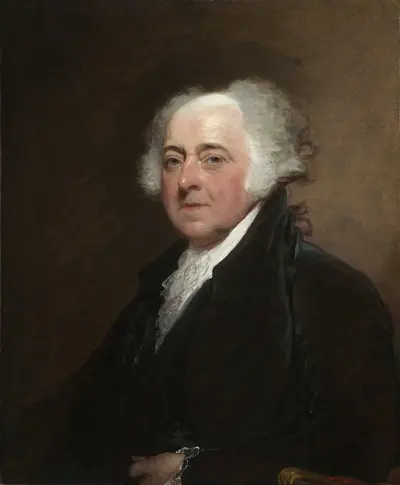
John Adams Jr. was an American statesman, attorney, diplomat, writer, and Founding Father who served as the second president of the United States from 1797 to 1801. Before his presidency, he was a leader of the American Revolution that achieved independence from Great Britain, and he served as the first vice president of the United States. Adams was a dedicated diarist and regularly corresponded with many important figures in early American history, including his wife and adviser Abigail Adams and Thomas Jefferson.
