Paulo Coelho Quotes
Our imagination is larger than the world around us; we go beyond our limits. This used to be called 'witchcraft,' but fortunately things have changed, otherwise we would both already have been burned at the stake. When they stopped burning women, science found an explanation for our behavior, normally referred to as 'female hysteria.' We don't get burned anymore, but it does cause problems, especially in the workplace. But don't worry, eventually they'll call it 'wisdom.'
Coelho, Paulo. The Witch of Portobello. Translated by Margaret Jull Costa, HarperCollins, 2007, p. 64.


The “liberal arts” at the time included the mechanical and technological arts and sciences including agriculture and manufacturing technologies.

Tesla was one of the great American immigrant scientists. He found in America the kind of intellectual and operational freedom that did not exist in the rigid, monarch-controlled, Austro-Hungarian Empire. He developed patents and techniques that formed the technological bases of radio, telephone long distance, TV, cell phones, Wi Fi, just to name a few. Most important he was Thomas Edison’s great nemesis. Edison invented DC electric generators that could power factories or entire streets in a neighborhood. Tesler invented and developed AC electrical technology which could power entire cities and he could move electricity over long distances. Tesler was the first scientist to conceive of an try to implement “Big Science” where there were huge capital investments to develop machines and systems to do what had never been done before—philosophically like the CERN Hadron Collider. Tesler even convinced a large corporation to finance the construction of a massive building and tower so he could experiment with the wireless transmission of electricity. However, as the industrial democracies have learned Big Science can only be funded by governments and it often takes sever working in consort to afford the huge investment that is required. In Tesler’s era, the federal and state governments did not fund scientific research so his was not only technically ahead of his time but also conceptually. He anticipated most of the problems and need for a national power grid that was challenging America even at the beginning of the 21st century.

Islamic modernists like Serageldin are many among the educated Muslims but their views are often drowned out by the violence and extremist statements of the fundamentalists. Ironically, the necessary intellectual freedom existed in the Islamic world one thousand years ago and Islamic science and other learning was as advanced as any and superior to most including the Christians.

There has been a suspicion and distrust of scientist by the general population in almost all societies throughout human history. Dewey thought America was entering a new intellectual enlightenment and there was an improvement for a short time, but scientists then tended to come under two criticisms by the general public. One was the new “knowledge” they were claiming which not only contradicted much of general religious dogma, but change started coming so fast that people were told to reject that which only a few years earlier they were told to accept and vica versa. At the same time, some groups in society began to be distrustful of scientists because they did not appear to be controllable by the means and methods of the rest of the society and were viewed as “loose cannons” who might not fit into democratic society in the manner that the leaders of society wanted. Both suspicions have existed since then.

Most modern feminists would not agree with this quotation by one of the great early femonists.


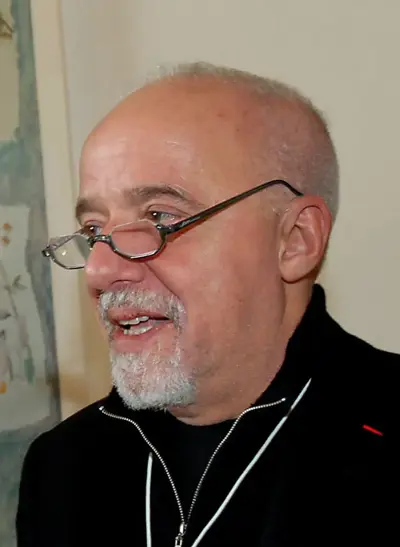
Paulo Coelho de Souza is a Brazilian lyricist and novelist, best known for his novel The Alchemist. In 2014, he uploaded his personal papers online to create a virtual Paulo Coelho Foundation.
