Elizabeth Cady Stanton Quotes
We are, as a sex, infinitely superior to men, and if we were free and developed, healthy in body and mind, as we should be under natural conditions, our motherhood would be our glory. That function gives women such wisdom and power as no male can possess.
Most modern feminists would not agree with this quotation by one of the great early femonists.
Elizabeth Cady Stanton, 1815-1902, First President, National Woman Suffrage Association Diary Entry, December 27, 1890
Sourced by: Eigen's Political and Historical Quotations


First female presidential candidate & first divorcee to run for that office

Jinnah was a modern Islamist who saw the role of females in a modern context. He, like the Indian Hindu leaders were in a sense products of the West and Western government and education. He would be very surprised that in his Pakistan men can murder their female relatives who they believe have dishonored the family, or that women would not be educated in the Madrassas, or that authorities could sentence a female relative of a man deemed guilty of seduction to be gang raped, but that is what happens in modern Pakistan. Jinnah and many of the early leaders believed that their new government could modernize Islam but the control and influence went the other way. Pakistan became a religiously dominated autocracy rather than the democracy that Jinnah foresaw.


The Greek culture was quite sexist. However, all cultures had observed strong women, some who ruled and others where wives or mistresses of rulers were very influential if not powerful.

This 12th century observation which appears so obvious has been ignored by the vast majority of Islamic scholars and writers subsequent until modern times, and even then they represent the small reform minority of Islamic thinking.


This observation has never been really taken seriously until the women’s movement stimulated historical and sociological studies to test such a hypothesis. More and more people are finding that Tocqueville may have been right on this point albeit still not a majority of scholarly opinion.
Much as a result of her efforts, New Zealand became the first country in the world to allow women to vote.


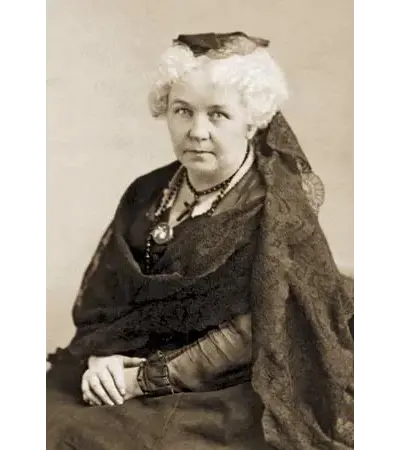
Elizabeth Cady Stanton was a leader of the women's rights movement in the U.S. during the mid- to late-1800s. She was the main force behind the 1848 Seneca Falls Convention, the first convention to be called for the sole purpose of discussing women's rights, and was the primary author of its Declaration of Sentiments. Her demand for women's right to vote generated a controversy at the convention but quickly became a central tenet of the women's movement. She was also active in other social reform activities, especially abolitionism.
