Josiah Strong Quotes
Our fifty principal cities contain 39.3 per cent of our entire German population, and 45.8 per cent of the Irish. Our ten larger cities only nine per cent of the entire population, but 23 per cent of the foreign.
Strong, Josiah. Our Country: Its Possible Future and Its Present Crisis. The Baker and Taylor Co., 1885, p. 130.


This was written just before Japan annexed Korea. See {613106}. It is true that Australia with vast land areas at the time was very racist and would only admit whites. America allowed some Asian immigration but limited it severely. After Japan’s defeat in WWII they solved their problem very easily. They practiced birth control and in the early 21st century Japan had a negative population growth. After World War II, there was a huge international emphasis on birth control and family planning as WWII in Asia was in part the result of overpopulation in Japan.
In the earliest white and Black subpopulations of Colonial America, “outsiders”—were commonplace. The original colonists were ALL immigrants. This tradition of acceptance and integration of outsiders has been very successful in America, Australia, and New Zealand compared with most cultures and nations that are more nativist and xenophobic. It also makes American nativist and anti-immigrants somewhat hypocritical given their own family origins. See {629005}.

At the time most people did not realize that the ability of a nation or land area to support a population was dependent more on agricultural and industrial productivity than on population size. In the most affluent and developed countries, land outside of the cities is quite affordable and available, whereas in poor, underdeveloped nations, land distribution and reform is still a factor. The majority of citizens of many developed, affluent nations do not own any land.


Howard was one of the first people to recognize the migration from the country to the cities brought about by the Industrial Revolution and then suggest solutions. He advocated planned suburban communities that had some elements of the country, but allowed a density of people to function in an industrial economy. He called them “Garden Cities”. Forest Hills in New York and other American planned communities were much influenced by his thinking as were many other new communities since.

This is a counter-intuitive fact which surprises almost everyone. Note that he does not claim that the entire world population could all live in New York, but the enormous amount of indoor space is clearly illustrated by the fact that all could fit in to the city.

The French were at the time considered the major barrier to growth and development of the colonies.

Roman citizenship had been reserved only for Romans. However, when Caesar spend extended time in Cleopatra’s Alexandria, he saw the effect of having a great center of learning in a city. It not only improved the quality of life, but the economic effect was profound as even though Rome was the most powerful Empire of the world, Alexandria was much larger, wealthier, and better developed. It was an effect not unlike that of a great university made throughout Europe later and America today. The scholars and intellectuals in sufficient numbers acted like a modern incubator.


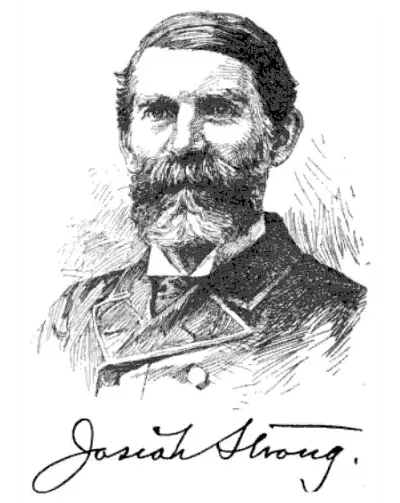
Josiah Strong was an American Protestant clergyman, organizer, editor and author. He was a leader of the Social Gospel movement, calling for social justice and combating social evils. He supported missionary work so that all races could be improved and uplifted and thereby brought to Christ. He is controversial, however, due to his beliefs about race and methods of converting people to Christianity. In his 1885 book Our Country, Strong argued that Anglo-Saxons are a superior race who must "Christianize and civilize" the "savage" races, which he argued would be good for the American economy and the "lesser races".
