John Marshall Quotes
Only its [the Constitution's] great outlines should be marked, its important objects designated, and the minor ingredients which compose those objects be deduced by the nature of the objects themselves.
John Marshall, 1755-1835, Chief Justice of the U. S. Supreme Court, U. S. Congressman (Federalist, VA), U. S. Secretary of War, U. S. Secretary of State McCulloch v. Maryland, 1819
Sourced by: Eigen's Political and Historical Quotations

Marshall is famous for, as Chief Justice, establishing the principle that the Judiciary can override Congress and the Executive in determining Constitutionality. However, as this quotation illustrates this principle had been discussed in open debate on the ratification of the Constitution. It was not simply a grab for power by a Chief justice; he uttered this quotation long before he ever suspected he would be a judge but actually spent much of his career in the executive and legislative branch of government.


In a 1949 dissenting opinion in Terminiello v. Chicago Jackson claimed the majority view would “convert the Bill of Rights into a suicide pact.”


Apparently the “faults and errors” of England and the United States in their constitutions were not so bad after all and it was Poland who subsequently had to rewrite and adopt new constitutions thereafter until 1997 when they seem to have adopted most of the “faults and errors.”


The view that the Supreme Court was the final arbiter of constitutional controversies was not held in early America.


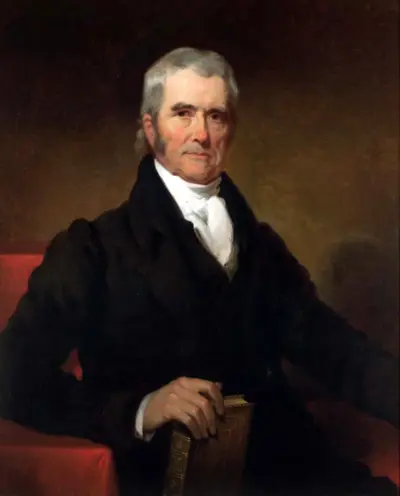
John Marshall was an American politician and lawyer who served as the fourth Chief Justice of the United States from 1801 to 1835. Marshall remains the longest-serving chief justice and fourth-longest serving justice in Supreme Court history, and he is widely regarded as one of the most influential justices to ever sit on the Supreme Court. Prior to joining the Supreme Court (and for one month simultaneous to his tenure as Chief Justice), Marshall served as the United States Secretary of State under President John Adams.
