Lyndon B. Johnson Quotes
... one of the most monumental laws in the entire history of American freedom.
Lyndon Baines Johnson, 1908-1973, 36th President of the United States (Democrat, TX), Description of the Voting Rights Act, 1964, Quoted in Jim Rutenberg, "Overcome", The New York Times Magazine, August 2, 2015
Sourced by: Eigen's Political and Historical Quotations


The marshal was embarrassed by his assignment to arrest this famous, elderly woman. He refused to handcuff her, gave her time to change her clothes, and took Anthony by streetcar to the courthouse trying to keep as low a profile as possible while Anthony was making speeches all the way about her unjust arrest. She was found guilty and fined $100 which she never paid.


This was the last public speech that Lincoln made before he was shot.


The law required voters to have a driver’s license or other picture ID issued by the Motor Vehicles Bureau. 300,000 adults in the state did not have a license. They tended to be more frequent among the poor, the elderly, and the minorities.


At the time Negroes were prohibited from voting by a series of discriminatory criteria for voter registration and intimidation so that Blacks would not generally even try to register. But the Civil Rights movement changed tactics and organized large scale attempts at voter registration. Mayor Thompson and the white power structure of the town were not going to allow that. They had not only enlarged the police department but the city purchased an a small armed tank.

First female presidential candidate & first divorcee to run for that office. The half to which she was referring were the females, who by many narrow laws were unable to participate in the intellectual and political life of the country. At the time, women could not even vote.


Preclearance was a requirement that any change in the voting or registration laws, rules or procedures needed to be approved by the Federal Justice Department. He was testifying about why preclearance was important and why it was placed in the Voting Rights Act every time it was reauthorized. See {635271} for what happens without preclearance.

In the aftermath of 9-11, there was a call for giving the law enforcement agencies more authority and the Patriot Act was passed in haste and fear. Some law enforcement personnel then went about picking up Arab Americans and in many cases holding them incommunicado without any charges. No terrorists were discovered by this process and yet good American citizens were abused, traumatized and insulted. In our zeal to protect American freedom, we actually began to resemble some of the capricious and abusive practices of our undemocratic enemies. There were other abuses allowed under the Patriot Act, but at the time of this writing the extent had not yet been revealed, but the refusal of the authorities to make public the national security benefits suggests that there was not much national security benefit and much abuse.

Originally it was published in Boston under the name “A Columbian Patriot.” This was written before the Bill of Rights had been added. Criticism like this led to their addition by Congress in order to obtain ratification.

Henry was advocating rejection of the Constitution without a Bill of Rights. He narrowly lost the vote, but his speech was one of the major catalysts for the later adoption of the Bill of Rights.

This phrase was also to be used over 100 years later by Malcolm X. See {624101} and {38291}.


While a Congressman under the Truman administration, Johnson was critical of federal measures to enforce civil rights.

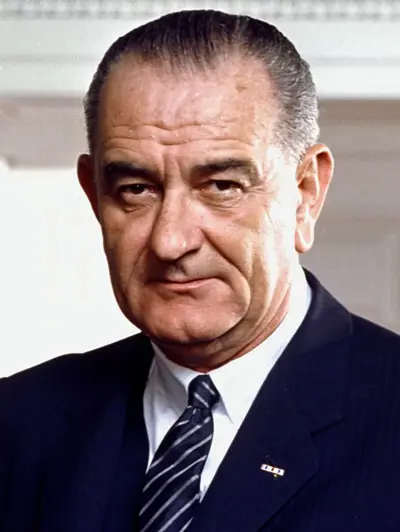
Lyndon Baines Johnson, often referred to by his initials LBJ, was the 36th president of the United States, in office from 1963 to 1969. He served as the 37th vice president from 1961 to 1963 and assumed the presidency following the assassination of President John F. Kennedy. A Democrat from Texas, Johnson was also a United States representative and later majority leader in the United States Senate. Johnson is one of only four people to have served, at various times, in all four federal elected positions.
