A. P. J. Abdul Kalam Quotes
One of the more difficult tasks for me as president was to decide on the issue of confirming capital punishment awarded by courts... to my surprise... almost all cases which were pending had a social and economic bias.
Kalam, A. P. J. Abdul. Turning Points: A Journey Through Challenges. HarperCollins Publishers India, 2012, p. 102.


Einstein had changed his mind. He like almost everyone else at the time favored the death penalty, but in 1927 came to the new conclusion for the same reasons that many American politicians stated 70 years later. He had no compunctions against capital punishment for murderers who were dangers to society, but the potential error of the justice system led him to oppose state sanctioned execution. At the time the number of errors in capital cases that had been demonstrated were few. But as a scientist, Einstein knew that all human endeavors were prone to error. He was a strong law and order supporter however—see {588606}.


In 1643 the Massachusetts Bay Colony wanted to dominate the region. Miantonomi, the Narragansett Indian Chief had a large well organized tribe who while friendly with the English were very independent. The Mohegan Indians, close allies of the colonists captured Miantonomi and turned him over to the Colony. Governor Winthrop’s actions have always been a disgrace to the justice of the Colony. Winthrop then turned him over to his traditional enemy, Chief Uncas, of the Mohawk to remove him from the boundaries of the Puritan Colony and then tomahawk Miantonomi to death. Winthrop actually sent several Puritan Englishmen to “see the execution for our more full satisfaction.” Among Miantonomi’s “evil” deeds was the fact that he gave Roger Williams, a religious and political dissenter from Winthrop’s Colony and religious “heretic”, a large tract of land (Providence) for his colony.


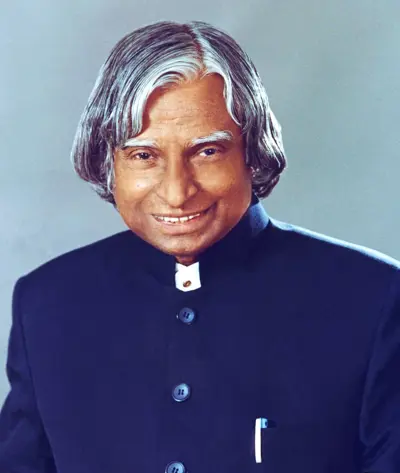
Avul Pakir Jainulabdeen Abdul Kalam was an Indian aerospace scientist and politician who served as the 11th President of India from 2002 to 2007. He was born and raised in Rameswaram, Tamil Nadu and studied physics and aerospace engineering. He spent the next four decades as a scientist and science administrator, mainly at the Defence Research and Development Organisation (DRDO) and Indian Space Research Organisation (ISRO) and was intimately involved in India's civilian space programme and military missile development efforts. He thus came to be known as the Missile Man of India for his work on the development of ballistic missile and launch vehicle technology. He also played a pivotal organisational, technical, and political role in India's Pokhran-II nuclear tests in 1998, the first since the original nuclear test by India in 1974.
