William McKinley Quotes
One hundred years ago free schools were little known in the United States. There were excellent schools for the well-to-do and charitable institutions for the instruction of boys and girls without means; but the free public school, open alike to the children of the rich and poor and supported by the State, awaited creation and development. The seed planted soon bore fruit. Free schools were the necessary supplement of free men. The wise and liberal provisions for public instruction by the fathers, second only in effect to their struggle for the independence and creation of the Union, were destined at no distant date to produce the most wonderful results.
Ironically, as important as education was to the early Americans, the words “education” and “school” never appeared in the Constitution nor is education even alluded to.
William McKinley, 1843-1901, 25th President of the United States (Republican, OH), Speech, University Of Pennsylvania, Philadelphia, February 22, 1898
Sourced by: Eigen's Political and Historical Quotations


It did not pass. Smalls had a hand in re-writing the Constitution of the State into which he had been born into slavery.


The phrase “national care and expense” was one that was seen as precedent for those advocating federal aid to education and a strong Department of Education. However, the majority of Adams contemporaries saw education, even public education, as a local matter. The word “education” or “school” never appeared in the Constitution. Adams was well before his time on this point.


Quoted in the Court’s notes of the meeting


The organization was initially called the National Negro Committee. The following year the name was changed to the National Association for the Advancement of Colored People. Note that at the time, even for Blacks, the concept of desegregation was so far from reality that their efforts were simply to have segregated schools with the same resources as the white children had. The “separate but equal” doctrine was the method of the segregationists.

The Freedmen’s Bureau was an institution established after the Civil War to provide assistance to the newly emancipated and free slaves. Every constructive step taken by the Bureau was opposed and obstructed by “unreconstructed” Southerners and some Northerners. They had very limited resources and there was little known technically about how to accomplish their mission. However, tens of thousands of individual new freed Negroes profited immensely and there were some systemic successes such as Du Bois describes in this quotation. There were also some failures he believed—See Quotation 643645.


This appears to be the first statewide free public education system available to the poor.


Alabama. Mississippi and the other states of the South have from the inception of the nation had a much poorer educational system (often no system at all). Even when Jim Crow discrimination was rampant in the South, the white schools were very poor and the Black schools terrible. At the end of the 20th century after integration, there were more serious attempts to improve education in the South and progress is being made to reach parity with the rest of the country. However, there is still in many Southern school boards hostility to science and other aspects of modern education and Southern states tend to censor school texts and library books this weakening the educational system. But progress is being made.


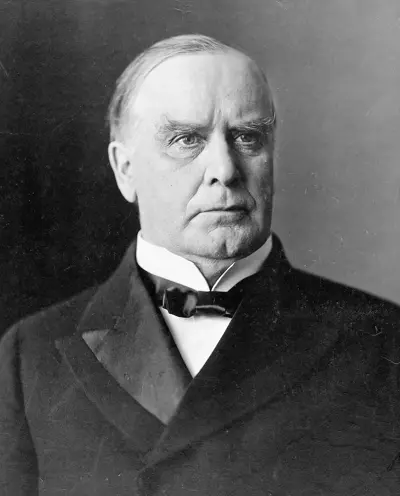
William McKinley was the 25th president of the United States, serving from 1897 until his assassination in 1901. McKinley was president during the Spanish–American War of 1898, raised protective tariffs to boost American industry, and rejected the expansionary monetary policy of free silver, keeping the nation on the gold standard.
