Karl Marx Quotes
One capitalist always kills many.
One of the contradictions of capitalism is that at many points in history capitalism has caused and/or contributed to great death and suffering. However, that same capitalism has led to the development of science, technology, agronomy, medicine and education which has saved and preserved millions of lives and raised the standard of living more than anything else.
Karl Marx, 1818-1883, German Economist & Socialist, Das Kapital (Book I), 1867
Sourced by: Eigen's Political and Historical Quotations


3rd Earl Russell of Kingston. He favored and argued for a middle ground of a capitalistic socialism or a socialized capitalism, which is what most democracies became.


Fitzhugh was a Southern iconoclast whose view of Northern labor was much like that of Karl Marx but who was an enthusiastic supporter of slavery.
This quotation is interesting for two reasons. First it is a good example of the twisted logic of some of the Slavery apologists who claimed that the Negro slave was better off than the free wage earner. The second reason is that it illustrates the norms of the treatment of the working man before the Civil War. The union movement would change the situation for the free laborer over the next century and then holidays and worker rights became normalized in American society. See {641290} for another of his absurd arguments.

At the time, there was generally only a single newspaper in an area in New Zealand.


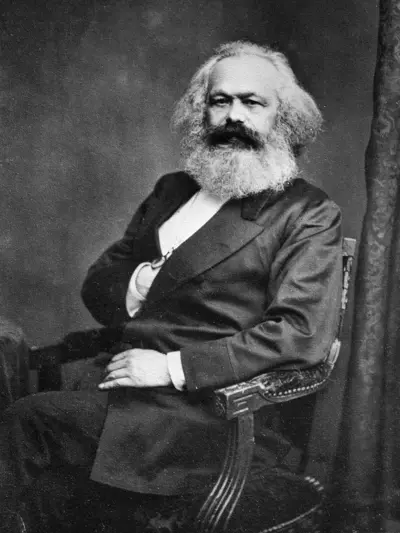
Karl Heinrich Marx was a German philosopher, economist, historian, sociologist, political theorist, journalist and socialist revolutionary. Born in Trier, Germany, Marx studied law and philosophy at university. He married Jenny von Westphalen in 1843. Due to his political publications, Marx became stateless and lived in exile with his wife and children in London for decades, where he continued to develop his thought in collaboration with German thinker Friedrich Engels and publish his writings, researching in the reading room of the British Museum. His best-known titles are the 1848 pamphlet The Communist Manifesto and the three-volume Das Kapital (1867–1883). Marx's political and philosophical thought had enormous influence on subsequent intellectual, economic and political history. His name has been used as an adjective, a noun, and a school of social theory.
