Francis Scott Key Quotes
No refuge could save the hireling and slave From the terror of flight, or the gloom of the grave, And the star-spangled banner in triumph doth wave, O’er the land of the free and the home of the brave.
The 3rd verse is rarely sung because of its reference to the then existing and generally accepted system of indentured servitude and slavery.
Francis Scott Key, 1780-1843, DC District Attorney,, Poet and Presidential Negotiator with the British, 3rd Verse, Star Spangled Banner, 1812
Sourced by: Eigen's Political and Historical Quotations


In one of the most unusual revolutions in world history, Brazil became independent from Portugal via a revolution led by the son of the Portuguese King and heir to the throne, Pedro I. The crown prince of Portugal, led Brazil in her breakaway from Portugal and by popular acclaim became Pedro I, Emperor of Brazil. He is probably the only monarch in history who was the heredity monarch of one kingdom and selected by popular acclaim to the throne of another.


As the U.S. flag was unfurled on the brig "Charles Dogget" before a voyage to Asia, the captain said:. This was the origin of the nickname for the American flag which later became so popular in the Civil War. The flag from that ship resides at the Smithsonian Institution.


Ataturk was a young major at the time commanding troops of a weak and corrupt Ottoman regime. However a combined English and French (the strongest military powers in Europe) invasion of the Gallipoli Peninsula threatened to capture the Turkish capital, Constantinople. Ataturk alone rallied the Turkish defenders and fought the invaders to a standoff in long drawn out battle with huge casualties on both sides. Ataturk became a national hero. Although Ataturk thereafter was very reluctant to use military force or endanger troops, the thing he always thought worth the supreme sacrifice (including his own) was the independence and sovereignty of the nation. See {584502} for his continuing belief in this type of sacrifice.

Federal authorities had jailed Glover pending his return to his Missouri owner. A local Wisconsin judge issued an order for Glover’s release on the grounds that slavery was illegal in Wisconsin and he was entitled to freedom. The Federal authorities refused to release the escapee. The Wisconsin mob then stormed the jail and broke Glover out. Glover was helped to get to Canada and final freedom by the people of Wisconsin, but Booth was prosecuted and convicted under the Fugitive Slave Act. He was later pardoned. See {587921}.


Referring to the British war dead:
In the attack on Fort Wagner, the color bearer was killed as was the Commanding Officer, Colonel Shaw. Carney raised the flag and led the men up the sand wall into the Confederate midst. They were vastly outnumbered and then retreated. Carney was the first Black to win the Medal of Honor.
Song traditionally sung at the end of British Labour Party meetings


This line was used in the WPA Federal Theater Project. The play was closed down, because the State Department was distressed that the Federal Theater quoting heads of State might be insulting to the world leaders. Mussolini was another character in the play and he was depicted as the boorish thug that he turned out to be. It was that which offended the government officials who closed the show before it could open. FDR used a similar line 6 years later. See {32529} . Dolores Ibarruri in the Spanish Civil War is quoted with a similar phrase at about the same time. See {604321}
The motto was worn on their uniforms which unlike the blue of the rest of the American army was white as can be seen in the famous paining by muralist David R. Wagner. Rhode Island offered freedom to all slaves who would enlist. It not only included Negroes but Indian slaves as well. See {613949} and {614120} for details. The motto itself is interesting in that there was little concept of a country then as most Americans identified themselves as Virginians, New Yorkers or Rhode Islanders. There was no Constitution—only a confederation of States. But the former slaves joining the regiment had never voluntarily associated themselves with Rhode Island, and the first free decision they made was to join the regiment and have a new country.

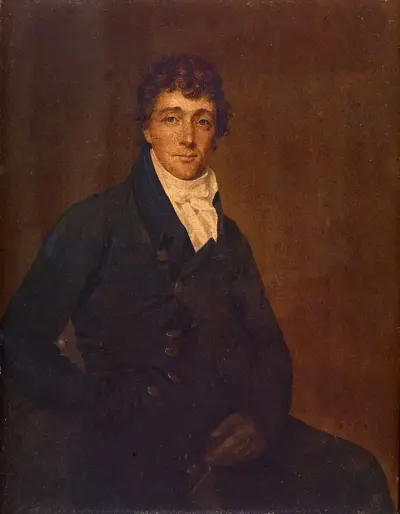
Francis Scott Key was an American lawyer, author, and amateur poet from Frederick, Maryland, who is best known for writing the lyrics for the American national anthem "The Star-Spangled Banner".
