Whitney M. Young Quotes
No race has a monopoly on vice or virtue, and the worth of an individual is not related to the color of his skin.
Young, Whitney M. Beyond Racism: Building an Open Society. McGraw-Hill, 1969.


The issue of slavery which had been suppressed in Congress for the first decades of the nation broke out when Missouri statehood was considered. By previous agreement, slavery was not even discussed in Congress but the time period elapsed. Tallmadge not only proposed that no more slaves could come into Missouri {613176} but most shocking to the Southerners was that every person born in the new state would be free at the age of 25. In a generation, there would be no more slavery in Missouri and there would be no economic compensation for slave owners at all. The House of Representatives accepted the amendment, but it failed in the Senate. At that time, Senators were not elected by voters but were appointed by the state legislators and the Southern slave states had a disproportionate share of the senate from a population point of view. But what this quotation shows clearly that a majority of the country in 1819 were opposed to slavery and were willing to end it without compensation.

It was not until this publication that people who suggested that discrimination and lack of education and opportunity might have something to do with the problem Blacks faced in society were regarded by many Americans as anything but left wing intellectuals.


Lieber was assigned by President Lincoln to study the then international laws of war and prepare a manual for the guidance of union troops in the Civil War. Lincoln then issued the document as a general order. This statement was critical in inhibiting the South from making good on their threat to enslave any Black Union Soldier Captured and to execute any Union Black soldier who was a runaway slave from the South. Lincoln threatened to retaliate and also to hold senior Confederate officers accountable for following these rules. General Sherman and other Union Senior Officers executed a few Confederate soldiers who violated rules of the order and the “illegal” practices stopped, and with few exceptions the senior officers of both sides followed Lieber’s rules. These rules, with few modifications, governed U. S. military policies and rules through the Second World War.

Nixon, in his second attempt to win the Presidency was told by a small group of Southern Republican politicians that his support was wavering in the South. They had already left the Democratic Party in reaction to the Passage of the 1964 Civil Rights Act. They were concerned because in order to try and capture some of the more liberal anti-war Democrats, Nixon had been making speeches advocating the vigerous enforcement of of civil rights and improving the lot of the Negro. But Nixon could not afford to lose his political base inb the south. Hence the promise which did not keep very long after he was elected President. Nixon was not a strong civil rights President, but he was totally without principles and had no political idiology he would sacrifice any of his political capital for. So once he was elected, he didn't want to offend the centerists whose support he needed for his legislatrive program so he did pay lip service to the prinicples of equality when he himself was anti-Black, andti-Semitic and prejudiced in many areas including against intelelctuals.


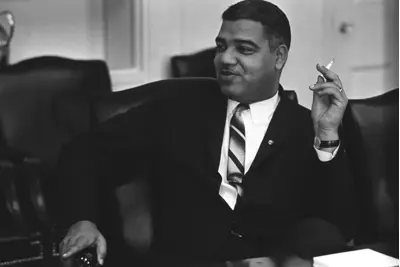
Whitney Moore Young Jr. was an American civil rights leader. Trained as a social worker, he spent most of his career working to end employment discrimination in the United States and turning the National Urban League from a relatively passive civil rights organization into one that aggressively worked for equitable access to socioeconomic opportunity for the historically disenfranchised.
