Leo Tolstoy Quotes
No one spoke of hatred of the Russians. The feeling experienced by all the Chechens, from the youngest to the oldest, was stronger than hate. It was not hatred, for they did not regard those Russian dogs as human beings, but it was such repulsion, disgust, and perplexity at the senseless cruelty of these creatures, that the desire to exterminate them — like the desire to exterminate rats, poisonous spiders, or wolves — was as natural an instinct as that of self-preservation
This intense depiction of the Chechen attitude towards the Russian was the kind of searing, description of reality that Tolstoy could do better than most writers in history. However it shows us that the Russian / Chechen conflict is much more than a current feud. It has existed for generations to have produced the reality which Tolstoy depicted in 1904. It also explains, in part, why, despite Western urgings, it has been very hard to initiate meaningful dialogue and negotiations between the Russians and the Chechens. Things are so personal, it is hard to get anyone who is interested in negotiating anything.
Leo Tolstoy, 1828-1910, Russian Writer & Philosopher, Hadji Murad, 1904
Sourced by: Eigen's Political and Historical Quotations

Odo of Chatillon-Sur-Marne. This is an amazingly distressing quotation for most moderns. Here we have the Pope preaching genocide and ethnic cleansing. This was one of the main triggers of the bloody Crusades and is not forgotten by Muslims in the Middle East Today. As Islam has not changed a great deal in 1000 years, most Muslims assume that the same is true of Christianity and especially the popes and the Roman Catholic Church. This is one of the reasons that the Islamic world reacts so strongly when a pope makes any statement negatve about Muslims and Islam.

The Hindus of Bihar had retaliated brutally to the earlier Muslim ethnic cleansing terror against Hindus. The atrocity by their own co-religionists was very shocking to the party leaders who realized for the first time that the "Blood for Blood" slogan and other incendiary oratory could have disastrous consequences. They realized that they had lost control and influence over their own followers and became really frightened as they seemed to be forced to accept the Muslim unreasonable dictates or accept the uncontrolled internecine civil war that ended up killing over 2 million Indians and displacing, raping and wounding more than 15 million more in the largest mass migration in human history.


These kinds of inflammatory sermons are delivered with the approval of the king and royal family who crack down on any cleric who preaches what they do not approve of.
Mehmet Talaat Pasha. This incredible quotation not only proves Talaat and the Young Turk Government was driving the extermination policy, but also admits that complete genocide was the policy. Talaat’s bizarre logic was this: We have killed so many Armenians that any remaining will certainly want revenge. Therefore, we have to exterminate them all lest they attempt to obtain justice at the expense of the Turks or even exact revenge against the Turks. The U. S. Ambassador was horrified at the Armenian genocide, and was constantly arguing with the Turkish officials to get them to modify their murderous policies. The Christian Armenians, a minority in Turkey and its lands, were discriminated against like other non Muslim minorities in the Ottoman Empire. But during the Turkish War with Russia and WWI, some Armenians defected and served on the Russian side. Many Turkish citizens took revenge on Armenians by means of murder and torture. Soon, the extermination of the Armenians became the official “Young Turk” government policy. Hundreds of thousands of Armenians were killed outright, and about an equal number were “deported” to special areas. Many died of malnutrition along the forced march of Ethnic Cleansing. Others were murdered as they were deported. No one knows exactly how many Armenians were killed with estimates ranging from ½ million to 4 million. This was the first genocide of the 20th century. Modern Turkish leaders however, are in denial about the Armenian deaths. They claim that there was a war and food was scarce; the only Armenians killed, the claimed were proven Russian agents. They further claim that the Armenian behavior was in large part responsible for the forced deportations because of their lack of patriotism and unwillingness to help the Turkish authorities identify the Russian agents. Most Turks today are unaware of the Armenian Genocide as nothing is taught about the massacres in schools or other institutions. It is against the law in Turkey to even have an intellectual study of the Turkish behavior towards the Armenians, much less publish anything about it.

The Serbs were in a conflict with the Ottoman Muslims almost 1000 years ago. However, they have never seen that war as having ended. When the Albanian Muslims were breaking from the weakened Ottoman Empire, the Serbs not only wanted to dominate Albania, but also to extract vengeance for alleged wrongs committed by Ottoman Muslims hundreds of years earlier. This attitude existed through and after the Serbian war and the Kosovo Albanian population would not live under Serbian control given the Serb war crimes and atrocities perpetrated on Muslims—not only in the historical past but even in the Serbian War. Tucovic was one of the very few Serbs who not only argued that the Serbian policy of oppression of the Muslims was not only morally wrong but counter productive from the Serbian point of view. For many Serbs, Tucovic was considered a traitor.

The Armenians were victims of ethnic cleansing where some were chased out and others killed in nearby Nakhijevan and Azerbaijan. The Armenians in turn have been persecuting those Armenian citizens who culturally identify or have origins in Nakhijevan or Azerbaijan. The hatred is so great that in this quotation the President of Armenia claims that the Government cannot protect the minorities because the minorities persecuted the Armenians in those countries where the Armenians were a minority. The conflict is also religious. Armenians are mostly Eastern Orthodox Christians while Nakhijevan and Azerbaijan are predominantly Muslim. Ethnically the Armenians were almost all exterminated in the early


The Alawites, always a Muslim minority in Syria, have been hated, distrusted, discriminated against, and physically persecuted by the majority Sunni Muslims as long as they have existed. When in Syria, the Alawites, although a minority, gained political control of the country and for the first time were secure in their own country. In the early 2000s, the Sunni majority tried to oust the Alawite leadership, but the Assad government put down the protests brutally. Most Western observers did not know of the anti-Alawite history of persecution in Syria. Returning to that position of victimization was so feared by the Alawites that they fought tooth and nail, murdering many civilians, to be sure that the historical position of the Alawites would not occur again. This makes talks and negotiations over the Syrian Civil War so difficult. The Alawites believe that if they do not control the nation, they will be massacred by the majority. The Christians and the Jews also believe that if the Sunni’s get control, their communities will be in great danger. Complicating the situation even further, is that fact that of the insurgent Sunni groups, the tolerant secular ones who started the revolution are no longer in control of the insurgents. De facto dominance has passed to the Jihadist, Islamic extremists who hold the view expressed by this quotation.


Paglia was an anti feminist. She never studied the intimidation effect of men who threaten their spouse’s lives if they are abandoned and each year many spouses and girlfriends are murdered for just that reason. Nor has she studied the millions of women who have no way to make a living yet have children to support who then stay with an abusive partner.

In the golden intellectual and science eras of Arabian Islam from 900-1300 individualism and independence of thought were much cherished virtues. In the 1100s, there began a period of theological and intellectual closing where the individual’s views were expected to conform to that of the then “proper” interpretation of the Koran and Islamic Dominance over all things. By the 1300s there were few Arab Muslims who would speak out for individual freedom of thought and rugged intellectual independence from the doctrine of the times. He was one of the few who advocated being back to the “old days” when Islam was far ahead of the intellectual thinking of the world. Few paid heed and Arab Islam has for the last 800 years been a shadow of its former intellectual achievements and has become a backward, stultified set of societies where one rarely finds an intellectual who does not depend on the community consensus and the values of the mullahs and muftis of the time rather than their own.


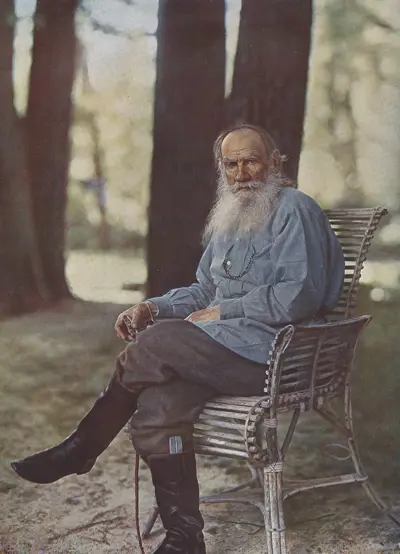
Count Lev Nikolayevich Tolstoy, 9 September, 1828 – 20 November, 1910), usually referred to in English as Leo Tolstoy, was a Russian writer who is regarded as one of the greatest authors of all time. He received nominations for the Nobel Prize in Literature every year from 1902 to 1906 and for the Nobel Peace Prize in 1901, 1902, and 1909. That he never won is a major controversy.
