Nikita Khrushchev Quotes
No one is born a Communist... in the Soviet Union farmers keep on looking in the barn for their horses even after they have given them to the collective.
Taubman, William. Khrushchev: The Man and His Era. W. W. Norton & Company, 2003.


At the Seventh World Congress of the Comintern in 1935 the new Popular Front policy was announced. To communist hard-liners and to the far left, the policy was an abandonment of the Marxist revolutionary line.

This quotation illustrates White’s favorable view of Russia. Note his use of the “it works” phrase which he picked up from Stefens’ famous quote {634892}. At the time the Soviet Union had been perceived by many economists to have been a great economic improvement over Czarist Russia. And over all, Russia which in 1917 was an economic basket case, had become one of the stronger states in Europe although the Russian people paid a horrendous price. Most historians agree that White passed classified information to the Russians. He was accused of being a Communist, but there was never any evidence of that. Some people believe that he was a spy for the Russians and committed espionage, but others disagree observing that White was very much his own man and felt that much information that was classified never should have been. White substituted his own judgment, it is believed, about what could be given to the Russians for the security system. He was an admirer of what Russian socialism had accomplished economically, educationally and medically since the 1917 revolution deposing the Czar. Russia had been a valuable military ally, which had taken the brunt of both military and civilian casualties in WWII. White’s economics were certainly not Marxist but very much Keynesian. He was subpoenaed by the House Un-American Activities Committee where he was accused of being a Communist which he denied (see {634907}). He died of a heart attack 3 days later.


Ataturk was not receptive toward Communism as some other world leaders were at the time. He saw its weakness far earlier than many others.


Supporters of medical reform include:


The Income tax had been ruled Constitutional by the Supreme Court in 1881, but the then “new” Court—the one that would render the Plessy v. Furgeson decision—was a more conservative one. By a 5-4 partisan decision, the Supreme Court reversed itself and killed the income tax until a Constitutional amendment could be passed 19 years later in 1913.

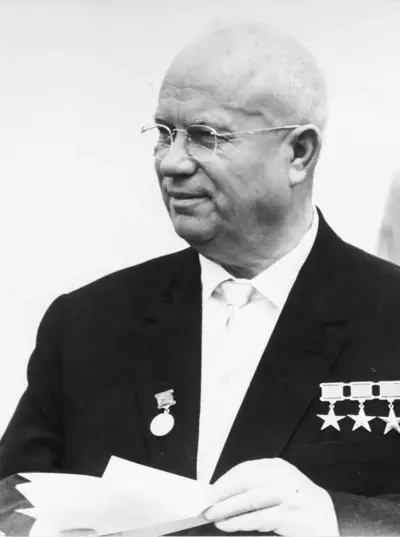
Nikita Sergeyevich Khrushchev led the Soviet Union as the First Secretary of the Communist Party of the Soviet Union from 1953 to 1964 and as chairman of the country's Council of Ministers from 1958 to 1964. During his rule, Khrushchev stunned the communist world with his denunciation of Stalin's crimes and began De-Stalinization. He sponsored the early Soviet space program, and enactment of relatively liberal reforms in domestic policy. After some false starts, and a near-nuclear war over Cuba, he conducted successful negotiations with the United States to reduce Cold War tensions. His proclivity toward recklessness led the Kremlin leadership to strip him from power, replacing him with Leonid Brezhnev as First Secretary and Alexei Kosygin as Premier.
