Stephen Kotkin Quotes
No one gives away their vote for free if somebody will pay for it.
Stephen Kotkin, Political & Economic Historian, Lecture, New School University, New York, December 7, 2001
Sourced by: Eigen's Political and Historical Quotations


In 1862 after a Sioux uprising, a U. S. military commission condemned 303 Indians to death. The President personally reviewed the records of each case and pardoned most. On December 26, 1862 the largest public execution in American history took place with 38 Indians hanged. Lincoln's decision to commute most of the sentences was not politically popular and in the 1864 election the Republican vote margin in Minnesota was smaller than before. Minnesota Senator Alexander Ramsey told Lincoln that he should have hanged more Indians and obtained a bigger majority.


Suggesting an arithmetic problem to be included in California textbooks:. "Supervisors" refer to members of the San Francisco Board of Supervisors, the equivalent to a city council.


The George W. Bush administration was trying to get its prescription drug plan through the House, but when the voting time ran out they did not have enough votes. The Republican leadership, for the first time in American Congressional history would not let the vote end and kept it open for another 3 hours while they persuaded some members to switch their vote. Smith was one of those. He had announced his retirement and his son was running for his seat. Tom Delay promised to support and campaign for his son, if Smith would switch his vote. Cunningham who was being given funds from companies, threatened to finance an opponent and hurt his son’s chances. In addition Cunningham was taking large bribes to steer contracts to incompetent contractors.


He was the Russian Reformer who ended serfdom and gave land to the peasants and then was assassinated for his liberality


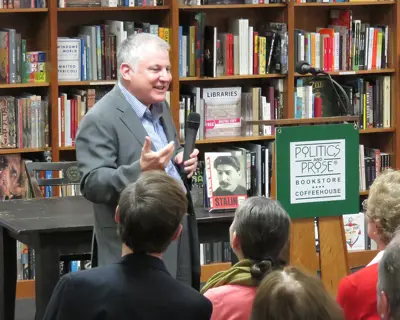
Stephen Mark Kotkin is an American historian, academic and author. He is currently the John P. Birkelund '52 Professor in History and International Affairs at Princeton University, where he is also co-director of the program in history and the practice of diplomacy and the director of the Princeton Institute for International and Regional Studies. He is also a senior fellow at the Hoover Institution at Stanford University. He has won a number of awards and fellowships, including the Guggenheim Fellowship, the American Council of Learned Societies and the National Endowment for the Humanities Fellowship.
