New York Tribune Quotes
No country in the world abounds in men of higher honor and integrity than the South, but where the question of Slavery is involved, justice and honor must stand aside, and the worst passions of the worst part of society become the ruling principle. The tyrant's plea of public danger and public necessity on such occasions overrides all laws, higher and lower, and the demagogue who bids highest for the public favor, by avowing the most malignant hatred of Abolitionism, is sure to obtain power. The honor of the South, therefore, cannot be trusted where the interests of Slavery are involved, because on such occasions the voice of honor and truth is always silenced by the clamor of low, brutal and selfish passions.
New York Tribune, Editorial, January 14, 1854
Sourced by: Eigen's Political and Historical Quotations


Even before we had a Constitution there was major opposition to slavery. The “price” of the American Union was the acceptance of the slavery of the South. But the hypocrisy of a country based on liberty to allow and enforce slavery was not lost on the founding fathers. Ironically the abolitionists among the founding fathers were certain that they could persuade the Southern slaveholders of the error of slavery in a few years and things would be set right in the land. Even George Washington {630626}, and Thomas Jefferson and some other slaveowners at the time wished to see its abolition. Slaveholding Southern Founding Fathers in general were so wary of the abolitionists that they achieved structural, disproportionate, power in the new Constitution to ward off the abolitionists attempts to reform slavery.

She was referring to the political leaders of the South who were patriots and slave owners.


This was part of his presentation to Northern influential business men showing them what he claimed was the New South. He was particularly complimentary about the negro Christian viewpoint that inhibited revenge or retaliation for their terrible treatment. The favorable lines about Negroes were well received by Northerners. However, they were mostly unaware of his racist views he expressed when in the South. See Quotation 643649.


Our Founding Fathers were divided into three general views about slavery. There were abolitionists for whom slavery was abominable and should be eliminated—these were mostly in the Northern States but with a few Southerners. Then there was the opposite view held by most Southerners, that slavery was not only a natural and moral institution but it was an economic and social necessity. Last were those like Laurens, George Washington and Thomas Jefferson. Slave owners who grew up with slavery as a norm but came to see its evils and the complexity of change and reform in that area.

Jefferson was one of the early observers that the the institution of slavery corrupted and depraved the whites.

The first sentence of this quotation was a favorite of Paine's. He had earlier used it in Common Sense in 1776. See {635451}.

He like others were very critical of Democracy and also of tyranny, but they had no positive solution as to what was acceptable.


1st Earl of Beaconsfield
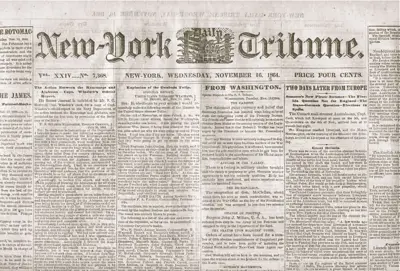
The New-York Tribune was an American newspaper, first established in 1841 by editor Horace Greeley. Between 1842 and 1866, the newspaper bore the name New-York Daily Tribune. From the 1840s through the 1860s it was the dominant Whig Party and then Republican newspaper in the United States. The paper achieved a circulation of approximately 200,000 in the 1850s, making it the largest daily paper then in New York City. The Tribune's editorials were widely read, shared, and copied in other city newspapers, helping to shape national U.S. opinion. It was one of the first papers in the north to send reporters, correspondents, and illustrators to cover the campaigns of the American Civil War.
