Lawrence Wright Quotes
Newspapers are a surprisingly good business in a country (Saudi Arabia) where the truth is so carefully guarded. Members of the royal family, Al Saud, are obsessively concerned about their image; they own or control most of the Saudi press, which dominates the Arab world. Within the kingdom, there are more than a dozen papers on the newsstands every morning. The most authoritative of them, and the most progressive, … are owned by Saudi princes but published in London. They are constrained by the same taboos that cripple all Saudi publications, however: nothing provocative can be said about Islam, the kingdom’s official religion; the government, which is effectively led by Crown Prince Abdullah; or the royal family, which is headed by King Fahd.
Lawrence Wright, Journalist, “The Kingdom of Silence”, The New Yorker, January 5, 2004
Sourced by: Eigen's Political and Historical Quotations

This set of guidelines not only denies the media freedom of expression but requires them to protect Saudi’s from information or views that might divert them from Islam. The media must by law protect the establishment of a particular religion.

In September of 2005 a Danish Newspaper published some political cartoons showing the hypocrisy of some Muslims who use Islam to justify murder of innocents and terrorism. Months later, in January of 2006 many in the Middle East protested vehemently and Muslim riots broke out because the Prophet Muhammad's visage was depicted against Islamic tradition. Many Muslim nations started a boycott against Denmark. Many Muslim leaders claimed that insulting religion was an “abuse” of freedom of speech including those from nations which regularly publish material that is virulent against Christians and Jews. Islamic country newspapers however, when it comes to what is perceived as material insulting to Islam, as typified by this editorial, feel that their religion should never be insulted despite the fact that Saudi Arabian media constantly insult Christianity and Judaism. Their justification of this gross double standard is that Islam is the “true” religion.

In September of 2005 a Danish Newspaper published some political cartoons showing the hypocrisy of some Muslims who use Islam to justify murder of innocents and terrorism. Months later, in January of 2006 many in the Middle East protested vehemently and Muslim riots broke out because the Prophet Muhammad's visage was depicted against Islamic tradition. Many Muslim nations started a boycott against Denmark. Many Muslim leaders claimed that insulting religion was an “abuse” of freedom of speech including those from nations which regularly publish material that is virulent against Christians and Jews. Westerners came to the support of Denmark. The United States which usually supports freedom of the press made this veiled criticism of the Danish Newspaper.


In September of 2005 a Danish Newspaper published some political cartoons showing the hypocrisy of some Muslims who use Islam to justify murder of innocents and terrorism. Months later, in January of 2006 many in the Middle East protested vehemently and Muslim riots broke out because the Prophet Muhammad's visage was depicted against Islamic tradition. Many Muslim nations started a boycott against Denmark. Many Muslim leaders claimed that insulting religion was an “abuse” of freedom of speech including those from nations which regularly publish material that is virulent against Christians and Jews.


In September of 2005 a Rose’s newspaper published some political cartoons showing the hypocrisy of some Muslims who use Islam to justify murder of innocents and terrorism. Months later, in January of 2006 many in the Middle East protested vehemently and Muslim riots broke out because the Prophet Muhammad's visage was depicted against Islamic tradition. Many Muslim nations started a boycott against Denmark. Many Muslim leaders claimed that insulting religion was an “abuse” of freedom of speech including those from nations which regularly publish material that is virulent against Christians and Jews. Apologies were demanded from Rose.


Vladimir Lenin. Lenin was echoing criticisms that were made the world over and even by some in the United States. However, his solution to have the press controlled by the ruling party just changed the cast of characters who were propagandizing and distorting the truth. Lenin was not able to offer a better solution nor were others. However, with enough affluence the capitalist society produced enough different publishers all competing that one did not dominate public opinion. With technology of TV and the Internet, the bar to entry is so small that almost anyone can be a publisher and find an interested market. In a way technology has solved much of the problem for capitalistic and totalitarian societies alike. In the latter, even censorship is not easy or feasible on a large scale.
The Interior Ministry has “responsibility” for the press in Saudi Arabia. Licenses are needed to publish a newspaper or magazine. The licenses are granted by the Interior Ministry. Editors keep close to Nayef and censor themselves based on his “guidance.” Wahhabism is a violent and fundamentalist version of Islam whose origins lay in Saudi Arabia. Ibn Taimaya was a 14th century Muslim cleric who preached a particularly radical form of Islam.


Tsvangirai’s party had won the election of 2008, but the Dictator Robert Mugabe refused to relinquish power. Sanctions against Zimbabwe by most of the world pressured Mugabe and Tsvangirai to accept a power sharing arrangement. However, Mugabe once the sanctions were lifted reneged on the agreement. He still controlled the state media which was, according to the 2008 agreement, to be completely non partisan. What this quotation shows is that the dictator maintained his control over the military, the police, and the media and with that really controlled the country.


Marlette was inundated by complaints from Muslims for his 2002 cartoon depiction of Muhammad driving a Ryder rental truck like the one used by convicted Oklahoma City terrorist bomber, Timothy McVeigh. The caption was, “What would Muhammad drive?” He was front-page news in Saudi Arabia and other Islamic nations. He received death threats. The Council on American-Islamic Relations and the Muslim World League both demanded an apology. Marlette refused. When he was killed in an automobile crash in July of 2007, many Muslims believed that this was the retribution of Allah.
In September of 2005 a Danish Newspaper published some political cartoons showing the hypocrisy of some Muslims who use Islam to justify murder of innocents and terrorism. Months later, in January of 2006 many in the Middle East protested vehemently and Muslim fatal riots broke out because the Prophet Muhammad's visage was depicted against Islamic tradition. Many Muslim nations started a boycott against Denmark. Many Muslim leaders claimed that insulting religion was an “abuse” of freedom of speech including those from nations which regularly publish material that is virulent against Christians and Jews.
In September of 2005 a Danish Newspaper published some political cartoons showing the hypocrisy of some Muslims who use Islam to justify murder of innocents and terrorism. Months later, in January of 2006 many in the Middle East protested vehemently and Muslim fatal riots broke out because the Prophet Muhammad's visage was depicted against Islamic tradition. Many Muslim nations started a boycott against Denmark. Many Muslim leaders claimed that insulting religion was an “abuse” of freedom of speech including those from nations which regularly publish material that is virulent against Christians and Jews.
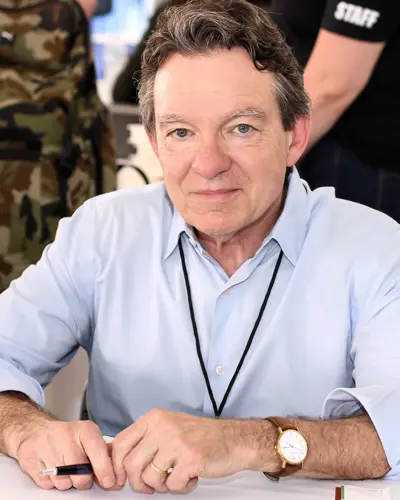
Lawrence Wright is an American writer and journalist, who is a staff writer for The New Yorker magazine, and fellow at the Center for Law and Security at the New York University School of Law. Wright is best known as the author of the 2006 nonfiction book The Looming Tower: Al-Qaeda and the Road to 9/11. Wright is also known for his work with documentarian Alex Gibney who directed film versions of Wright's one man show My Trip to Al-Qaeda and his book Going Clear. His 2020 novel, The End of October, a thriller about a pandemic, was released in April 2020 during the COVID-19 pandemic, to generally positive reviews.
