Fulton J. Sheen Quotes
Never will we be able to understand our times if we naively 'think' of this system of self Government as the work of a few gangsters or the creation of a pack of criminals we call a political party. The appeal of Socialism, Fascism and communism was principally negative; they were protests against a live and let live anything goes liberalism, a spineless indifference to causes, a failure to recognize that nothing was evil enough to hate, and nothing was good enough to die for.
Sheen, Fulton J. Philosophies at War. Charles Scribner's Sons, 1943, p. 35.


Despite the fact that many Americans saw communists and socialists as of the same ilk, socialists were very suspicious of communists—especially the “party discipline” and the lack of individual freedom, while the communists saw the socialists as just another form of fascism and attacked it violently. Later, the party line against socialists softened as Cold War communist strategy solicited assistance from the socialist, unaligned nations.

The Priest was the right wing demagogic radio host of his day. Virulently anti-Semitic and anti-Black, he was threatened with excommunication by the Catholic Church, which finally ordered him to cease us weekly radio show and stop the political hate.


Hayek uses this line to explain that fascism may emerge when communism—or belief in its promise—fails, as seen in Stalinist Russia and pre‑Hitler Germany.


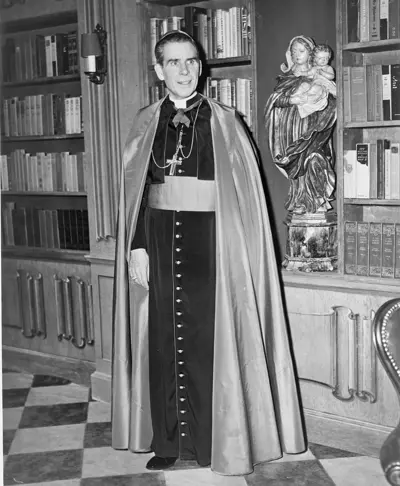
Fulton John Sheen was an American bishop (later archbishop) of the Catholic Church known for his preaching and especially his work on television and radio. Ordained a priest of the Diocese of Peoria in 1919, Sheen quickly became a renowned theologian, earning the Cardinal Mercier Prize for International Philosophy in 1923. He went on to teach theology and philosophy at the Catholic University of America as well as acting as a parish priest before being appointed Auxiliary Bishop of the Archdiocese of New York in 1951. He held this position until 1966 when he was made the Bishop of Rochester. He resigned in 1969 as his 75th birthday approached, and was made the Archbishop of the titular see of Newport, Wales.
