Robert Byrd Quotes
Never have I seen such a monstrous piece of legislation. Without a single committee hearing we are being asked to vote on that 484 pages. They think we will all go along with it. I read in the paper that nobody will have the courage to vote against it. Well, Robert Byrd is going to vote against it because I don't know what I am voting for.
Robert Byrd, 1917-2010, U. S. Congressman & U. S. Senator (Democrat, WV), Response to the Republican controlled Senate attempt to add earmarks and other pork to a general bill that everyone favored, 2000
Sourced by: Eigen's Political and Historical Quotations

The bills and legislative processes in Congress had become so large and convoluted that literally members of Congress either voted on bills that were so lage that they rarely read the entire bill or on procedures so arcane that the members could not determine ehate they were voting for. As a result most just followed the lead of their party's Congrssional Leadership.

His Republican controlled House of Representatives frequently were presented with the leadership with a vote they had to make on legislation which the minority Democrats, and often many of the Republicans, did not have any opportunity to know the details of the legislation on which they were voting.

In general, there are so many versions of a bill as it goes through the Congressional process, that the members of Congress do not read each and every draft. Some do not read any of the drafts and leave it to the Committee; others trust their staffs or their party leadership. More often they trust the lobbyists who donate to their campaigns. Sometimes, the bills are so large—many thousands of pages that the members of Congress lose track of all the aspects of the proposed law and only read a few sections in which they may have participated in debate. Often, the only people who read the entire bill are the lobbyists and one or two of committee staff.


Louis had maintained that the earmark was a cowardly and corrupt way of a congressman bringing pork back to their districts and paying back campaign contributors. He argued that if what the Congressmen were doing were right, why not introduce a bill publicly, debate it, defend it, and try to get a majority for it rather than sneak it in some large piece of legislation without anyone knowing who even introduced the legislation or got the pork into the bill.


See Henry Clay for an earlier expression of this point.

In the summer of 1989 the House was anxious to adjourn for the summer recess but the savings and loan bailout legislation was stalled. The leaders of both parties forged a compromise which was not enthusiastically received by their members. A Democratic leader advised:


At the time most legislatures never had recorded votes but instead often depended on voice votes and other methods. Edison’s invention was a huge failure. Transparency was not a popular concept amongst politicians as it still is not, but some standards have changed.


Hollings who was one of the senior experienced senators was offended by the degree to which the George W. Bush Administration and the Republican leadership had turned to lobbyists to draft legislation and amendments to pending legislation. Lobbyists often have specialized information that members of Congress do not have, so there has been in modern times communications between lobbyists and members of Congress and their staffs. However, during the Bush Presidency the practice reached an extreme where lobbyists would even write the legislative language and give it to the members in whom they had invested by giving them large campaign contributions and many perks. K Street is the fanciest street in Washington DC with some of the most expensive office space. A substantial proportion of the lobbyists have K Street offices, hence the metaphor.

For complex legislation, there are very few members of Congress who vote on the legislation who could honestly say that they have read the entire bill. Breyer and many others do not see this as a major problem; many others consider it a disgrace that members of Congress will vote for or against a law that they have not even read.


See Brady {640935} for a later version of this idea.
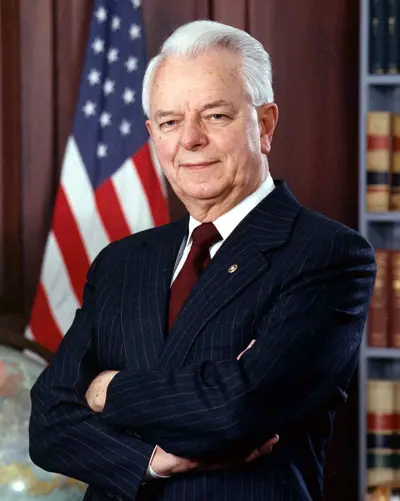
Robert Carlyle Byrd was an American politician who served as a United States Senator from West Virginia for over 51 years, from 1959 until his death in 2010. A member of the Democratic Party, Byrd also served as a U.S. Representative for six years, from 1953 until 1959. He remains the longest-serving U.S. Senator in history; he was the longest-serving member in the history of the United States Congress until surpassed by Representative John Dingell of Michigan. He was the last remaining member of the U.S. Senate to have served during the presidency of Dwight Eisenhower, and he was the last remaining member of Congress to have served during the presidency of Harry S. Truman. Byrd is also the only West Virginian to have served in both chambers of the state legislature and both chambers of Congress.
