Donald Rumsfeld Quotes
Napoleon was asked, "Who do you consider to be the greatest generals?" He responded saying, "The victors.
Rumsfeld, Donald. Rumsfeld's Rules: Leadership Lessons in Business, Politics, War, and Life. Broadside Books, 2013.

The General refused. He had already achieved a strategic victory and it was only a matter of time when the Dutch would withdraw on their own as their supply lines were cut off and the populations wanted them out.

He polished the army but had little strategic appreciation for the strengths of the Union, its industrial capability, logistical capability, and its greater manpower pool. He was reluctant to fight, and when he did, was happy to take territory, that meant little, when Lincoln and other strategists argued that the object should be to destroy and degrade the Confederate Army and the Confederate capacity to support the Army and continue to make war.


His aggressive tactics which had served him so well in the West got his army into trouble at the Second Battle of Bull Run, where he was out maneuvered by Stonewall Jackson and Robert E. Lee. He was sent back to the West.


General Shafter had a major attack of Gout, a terribly painful disease for which there was little relief at the time. As a result he had little involvement in the battle of Santiago at the most critical period. Crassus was an incompetent general in a famous Roman battle.

Not understanding this point has been the cause of much difficulty for military leaders from the war of 1812 through the Iraq war, the success or failure of the effort depended on a successful peace.
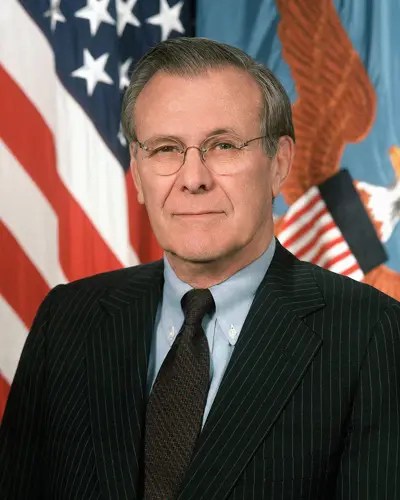
Donald Henry Rumsfeld is a retired American politician. Rumsfeld served as Secretary of Defense from 1975 to 1977 under Gerald Ford, and again from January 2001 to December 2006 under George W. Bush. He is both the youngest and the second-oldest person to have served as Secretary of Defense. Additionally, Rumsfeld was a three-term U.S. Congressman from Illinois (1963–69), director of the Office of Economic Opportunity (1969–70), counsellor to the president (1969–73), the United States Permanent Representative to NATO (1973–74), and White House Chief of Staff (1974–75). Between his terms as Secretary of Defense, he served as the CEO and chairman of several companies.
