F. W. de Klerk Quotes
My predecessor, P. W. Botha, had an inner circle, and I did not like it. I preferred decisions to evolve out of cabinet discussions. That way, we achieved real co-ownership of our policies.
De Klerk, F. W. The Last Trek: A New Beginning. Macmillan, 1998, p. 147.


In 1933 the incoming President, Franklin Delano Roosevelt, personally took charge of the U. S. delegation at the World Disarmament Conference in Geneva, much to the disappointment of professional diplomats at the State Department:


Some people get upset when they learn that members of the President’s cabinet disagreed with the president on a major policy. Yet this is very common and very desirable as long as when the President reaches his/her decision, the dissenters all close ranks and implement it. Some Presidents are not secure enough or confident enough to be comfortable with dissent. The greatest of our Presidents were known for their selection of strong advisors who have different perspectives. President Lincoln had all his rivals for the Presidency in his cabinet. Franklin Roosevelt appointed a number of Republicans to his cabinet and a left wing socialist also. Theodore Roosevelt’s Secretary of State, Elihu Root, was famous for telling the President where Root thought he was wrong. George Washington had Thomas Jefferson and Alexander Hamilton in his cabinet and they fought like cats and dogs. Jefferson ran against Washington’s Federalist party and destroyed that party at the polls. However, the nation was better for these brilliant, experienced cabinet members helping a strong President to make consider all possibilities and make better decisions.


Bush assumes that this meant that all the people agreed with his decision to invade Iraq. While that might have been the case, there are other possibilities that many historians, journalists and other analysts have suggested. The Vice President, and his personal staff, were known to have visited them all and lobbied for the invasion. They pressured several of them who may have not wanted to run afoul of what seemed to be the most powerful vice president in American History. Or they may have thought that the decision had already been made, and it was time to join together and loyally support the policy decision that had been made. There were few strong independent thinkers in the top tier as Bush was not intellectually or emotionally inclined to have open staff arguments to work out a policy or very strong advisors with different points of view. The strongest of the advisors like Secretary of State Colin Powell had been lied to and persuaded there was “clear evidence” that Iraq was about to deploy a nuclear weapon. This made Powell an advocate. The intelligence given to Powell and the others was wrong and much was fabricated or obtained from an unreliable source who had been pushed as trustworthy by the Vice President. The CIA Director, had told those all that the evidence and case for the fact that Iraq was developing and close to deploying a nuclear weapon was a “slam dunk”.


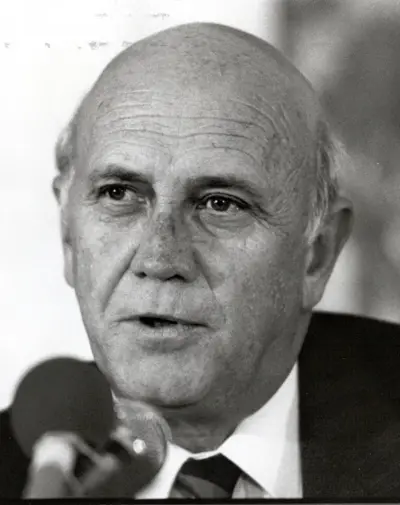
Frederik Willem de Klerk OMG DMS is a South African retired politician, who served as State President of South Africa from 1989 to 1994 and as Deputy President from 1994 to 1996. As South Africa's last head of state from the era of white-minority rule, he and his government were forced to dismantle the apartheid system and introduced universal suffrage. Ideologically a conservative and an economic liberal, he led the National Party from 1989 to 1997.
