George W. Bush Quotes
When I made the decision on Iraq, I went around the room to everybody at that table, every principal. You in? Any doubts? Nothing from anybody.
Bush assumes that this meant that all the people agreed with his decision to invade Iraq. While that might have been the case, there are other possibilities that many historians, journalists and other analysts have suggested. The Vice President, and his personal staff, were known to have visited them all and lobbied for the invasion. They pressured several of them who may have not wanted to run afoul of what seemed to be the most powerful vice president in American History. Or they may have thought that the decision had already been made, and it was time to join together and loyally support the policy decision that had been made. There were few strong independent thinkers in the top tier as Bush was not intellectually or emotionally inclined to have open staff arguments to work out a policy or very strong advisors with different points of view. The strongest of the advisors like Secretary of State Colin Powell had been lied to and persuaded there was “clear evidence” that Iraq was about to deploy a nuclear weapon. This made Powell an advocate. The intelligence given to Powell and the others was wrong and much was fabricated or obtained from an unreliable source who had been pushed as trustworthy by the Vice President. The CIA Director, had told those all that the evidence and case for the fact that Iraq was developing and close to deploying a nuclear weapon was a “slam dunk”.
George W. Bush, 43rd President of the United States, Son of President George W. Bush, Description of the total concurrence of his Cabinet, Intelligence, and National Security Advisors with his decision to invade Iraq to stop them from deploying weapons of mass destruction, Quoted in Peter Baker, Days of Fire, 2013
Sourced by: Eigen's Political and Historical Quotations

Galloway, a witness before the committee who had always criticized the American and British Policy of Iraq invasion to eliminate weapons of mass destruction, had also predicted the insurrection and resistance to the American and British occupation had been attacked by Coleman for taking campaign contributions from British Islamic terrorists—see {616260}. Coleman expected the typical American hearing behavior where Senators can berate witnesses who generally behave docilely in defending themselves. He was not used to the English style of political debate which is much more aggressive and Colemen was nonplussed when Galloway came up with this put down.


President George W. Bush initiated an invasion of Iraq based on the fact that Iraq was developing nuclear, chemical and biological weapons. After the invasion however, there were none of these weapons found and much evidence that there were not any at that point in time. By the time Congress, the body which is supposed to declare war, found out that the reason for the war was bogus, it was too late. We had already occupied the country and were in the midst of a civil war. The President either acted on bad intelligence or wanted to invade Iraq for other reasons and history may finally tell us which, but Fein sees the problem as too much secrecy in the executive branch.

While to Madison the principle that “war is better than tribute” was “settled policy”, there were many who disagreed. See {640867} as an example.


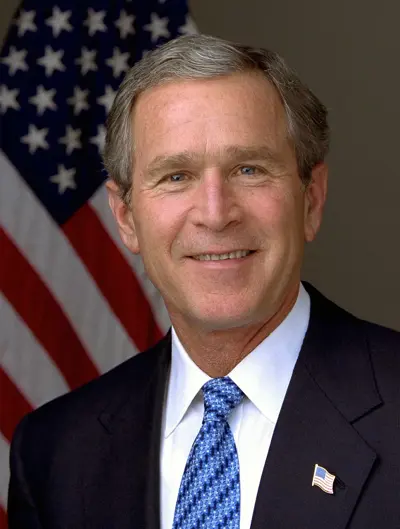
George Walker Bush is an American politician and businessman who served as the 43rd president of the United States from 2001 to 2009. A member of the Republican Party, Bush previously served as the 46th governor of Texas from 1995 to 2000. He was born into the Bush family; his father, George H. W. Bush, was the 41st president of the United States from 1989 to 1993.
