Lyndon B. Johnson Quotes
My generals are always right about other people’s wars and wrong about our own.
Lyndon Baines Johnson, 1908-1973, 36th President of the United States (Democrat, TX), Statement to Abba Eban in reaction to the correct American military assessments that the Israeli’s would defeat the Arabs while predictions about Vietnam were less reliable, May 1967
Sourced by: Eigen's Political and Historical Quotations


Ironically, Lieberman was using this quotation to campaign against Bush’s son, George W. Bush.

See a similar sentiment by Tallyrand

The General refused. He had already achieved a strategic victory and it was only a matter of time when the Dutch would withdraw on their own as their supply lines were cut off and the populations wanted them out.

On military or foreign policy matters his view was that presidents ought not to rule anything in or out so that he/she can keep all the options open and not reduce future flexibility.


Written when he was forced to share command with General Francois Kellerman.


ground troops fighting in Iraq & Syria in addition to air power Quote A was made in June of 2014. Quote B, 3 months later in September. In June there are rumors that the Obama administration might commit more military assets to the situation in Iraq and Syria and Graham was afraid that the President might be considering ground troops. Three months later, President Obama announced a policy of making a serious military commitment to the area, but stated that he would not be using ground troops. Graham then criticized the President for NOT deploying ground troops reversing his previous position. This is a marvelous example of the hyper partisanship and the virulent anti-Obama action by the Republicans. Actually, Graham was better than most of the Republicans. He was always polite. He criticized the President’s policies and actions even if he had to twist around to do it. Many of his colleagues made vicious personal attacks on the President and kept spreading rumors that he was not a Christian but a Muslim who was not born in America and was indoctrinated in Islam as a boy. Graham’s flip flop was explained by him as a change that was made necessary by the rise and military aggression of ISIS which he also blamed on the President for not committing more resources to the Syrian insurgents.


Devine was then the clandestine CIA officer in Chile who sent a secret cable to Washington 3 days before the military coup and the murder relaying the date of the coup and who was involved—see {86577}. Devine claimed he nor other Americans, actually plotted with the Chilean military, however he and others certainly have the "green light" indicating that the United States would have no objection to the coups.

General Shafter had a major attack of Gout, a terribly painful disease for which there was little relief at the time. As a result he had little involvement in the battle of Santiago at the most critical period. Crassus was an incompetent general in a famous Roman battle.

Roosevelt promoted Eisenhower over more than 300 more senior generals and put him in charge of the American Forces invading North Africa—the first American combat in the war. In addition to commanding the American forces, he was also responsible for dealing with many leading politicians from Winston Churchill to the very difficult French General Charles De Gaulle. That is why Eisenhower was picked, and a brilliant pick it was.

In the aftermath of World War I the Greeks invaded Turkish held Smyrna to "protect" the ethnic Greek population there. It was a great military blunder and exposed the Greek military to the Turks. This isI a candid private statement of the fact that admission of a military blunder would cause the government to fall that never was made public,

Chamberlain’s policy was to appease Hitler and Germany to avoid war. Although he did not see Czechoslavkia as a critical British national interest and claimed he had secured peace {585941} , the reality was that he gave Germany room to start its aggression which would engulf all of Europe and much of the world. The British became the only bulwark against Hitler until the Russians stopped the Germans and America entered the war.
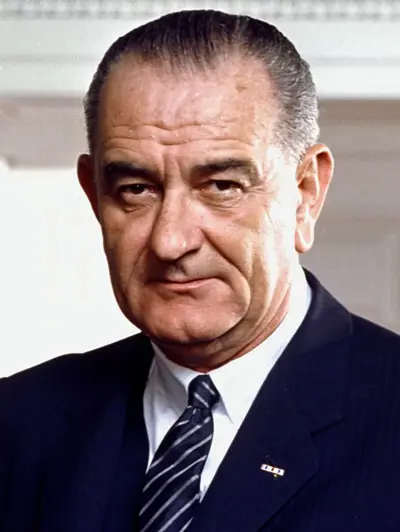
Lyndon Baines Johnson, often referred to by his initials LBJ, was the 36th president of the United States, in office from 1963 to 1969. He served as the 37th vice president from 1961 to 1963 and assumed the presidency following the assassination of President John F. Kennedy. A Democrat from Texas, Johnson was also a United States representative and later majority leader in the United States Senate. Johnson is one of only four people to have served, at various times, in all four federal elected positions.
