Tariq Ramadan Quotes
Muslims must speak out and explain who they are, what they believe in, what they stand for, what is the meaning of their life. They must have the courage to denounce what is said and done by certain Muslims in the name of their religion.
Ramadan, Tariq. What I Believe. Oxford UP, 2009.


English Muslim terrorist organization. This quotation illustrates what is perhaps the greatest difference between Muslims and most members of other religions. Most others think of their personal identity in national terms and then occupational, religious and racial. A Christian might say ‘I am a French Attorney who is a Christian’; a Buddhist , ‘I am a Cambodian Buddhist. But most Muslims would say, ’I am a Muslim from France’ or a ‘Follower of Islam residing in Lebanon.


This phrase has been used by fundamentalists to justify forced conversion and the imposition of religious law—Sharia—on believers and unbelievers alike. The logic is that if God says believing orthodox Mosems are the best, that is what he wants for all. And therefore by forcing others to be orthodox and of the faith, one is doing God’s bidding. See Husain Haqqani, “Islam’s Medeval Outposts,” Foreign Policy November/December, 2002.


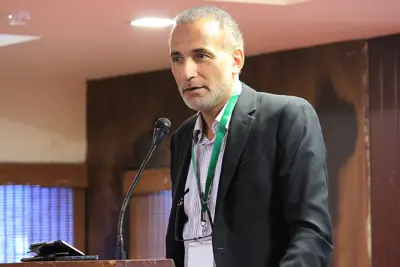
Tariq Ramadan is a Swiss Muslim academic, philosopher, and writer. He was a professor of contemporary Islamic studies at St Antony's College, Oxford and the Faculty of Theology and Religion, University of Oxford, but as of 2018 is taking an agreed leave of absence. He is a visiting professor at the Faculty of Islamic Studies at Hamad Bin Khalifa University in Qatar, and the Université Mundiapolis in Morocco. He is also a senior research fellow at Doshisha University in Japan. He is the director of the Research Centre of Islamic Legislation and Ethics (CILE), based in Doha. He is a member of the UK Foreign Office Advisory Group on Freedom of Religion or Belief. He was elected by Time magazine in 2000 as one of the seven religious innovators of the 21st century and in 2004 as one of the 100 most influential people in the world and by Foreign Policy readers (2005, 2006, 2008–2010, 2012–2015) as one of the top 100 most influential thinkers in the world and Global Thinkers. Ramadan describes himself as a "Salafi reformist".
