Vitruvius Quotes
Music, also, the architect ought to understand so that he may have knowledge of the canonical and mathematical theory, and besides be able to tune ballistae , catapultae, and scorpiones to the proper key. For to the right and left in the beams are the holes in the frames through which the strings of twisted sinew are stretched by means of windlasses and bars, and these strings must not be clamped and made fast until they give the same correct note to the ear of the skilled workman.
Vitruvius. Vitruvius: The Ten Books on Architecture. Translated by Morris Hicky Morgan, Harvard University Press, 1914, p. 8.


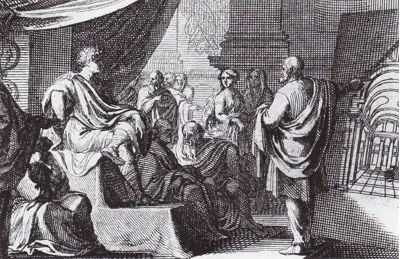
Marcus Vitruvius Pollio (/vɪˈtruːviəs ˈpɒlioʊ/; c. 80–70 BC – after c. 15 BC), commonly known as Vitruvius, was a Roman author, architect, and civil and military engineer during the 1st century BC, known for his multi-volume work entitled De architectura. He originated the idea that all buildings should have three attributes: firmitas, utilitas, and venustas ("strength", "utility", and "beauty"). These principles were later widely adopted in Roman architecture. His discussion of perfect proportion in architecture and the human body led to the famous Renaissance drawing of the Vitruvian Man by Leonardo da Vinci.
