Kenneth M. Pollack Quotes
More likely, there were probably some real divisions within the Iranian government - some groups wanted to ally with al Qaeda against us, others didn't want to have anything to do with that. So I think that debate resulted in no decision being made for awhile. The problem was they left the al-Qaeda folks in Iran in the hands of their intelligence services and Revolutionary Guard, who didn't really keep an eye on them - and may not have kept an eye on them on purpose.
Gilson, Dave. "The Persian Puzzle." Mother Jones, 30 Nov. 2004.


Inspire Magazine was the official propaganda magazine of Al Qaeda.

He had continuously been accused of not going after the infamous terrorist who people were suspecting was hiding in Pakistan. The President had heard these reports but maintained that he did not know where bin Laden was. On this occasion he challenged his challenger.

36 days later, September 11, he did strike, and at the World Trade Center. The memo was kept secret by the Bush administration until public pressure as a result of the 9-11 Commission hearings forced the declassification and release. At that point it became clear that there was no reason that the memo could not have been released much earlier except that it was embarrassing.
36 days later, September 11, he did strike. See {617467} for some of the specific contents. The memo was kept secret by the Bush administration until public pressure as a result of the 9-11 Commission hearings forced the declassification and release. At that point it became clear that there was no reason that the memo could not have been released much earlier except that it was embarrassing. See {637530} and {637533} for two other Bin Laden Warnings that Bush and his team ignored.


Bush claimed he did not remember the conversation. His incoming National Security Advisor, Condoleezza Rice, was also briefed about bin Laden by the Clinton anti-terrorism director, Richard Clarke. The Bush Administration ignored the warnings until bin Laden struck on 9-11


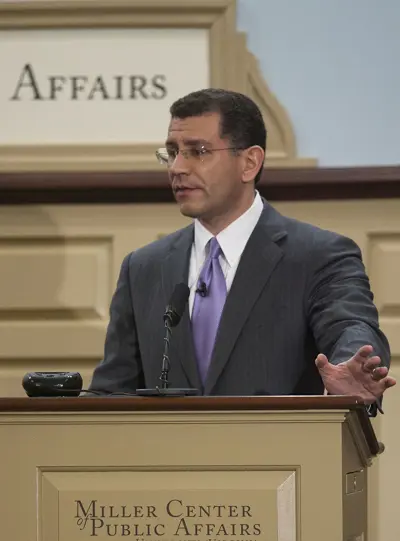
Kenneth Michael Pollack (born 1966) is an American former CIA intelligence analyst and expert on Middle East politics and military affairs. He has served on the National Security Council staff and has written several articles and books on international relations. Currently, he is a resident scholar at the American Enterprise Institute, "where he works on Middle Eastern political-military affairs, focusing in particular on Iran, Iraq, Saudi Arabia, and the Gulf countries. Before that he was Senior Fellow at the Saban Center for Middle East Policy at the Brookings Institution and a Senior Advisor at Albright Stonebridge Group, a global business strategy firm.
