Robert Browning Quotes
Mid the sharp, short emerald wheat, scarce risen three fingers well,
The wild tulip at the end of its tube, blows out its great red bell,
Like a thin clear bubble of blood, for the children to pick and sell.
Browning, Robert. "Up at a Villa--Down in the City." Men and Women. Vol. 1, Chapman and Hall, 1855, p. 24.


Many ministers and others looked at the migration of the rural population to the cities as a national issue of morality and decay. They fought a losing battle. See {631005} for his puzzlement and its details.


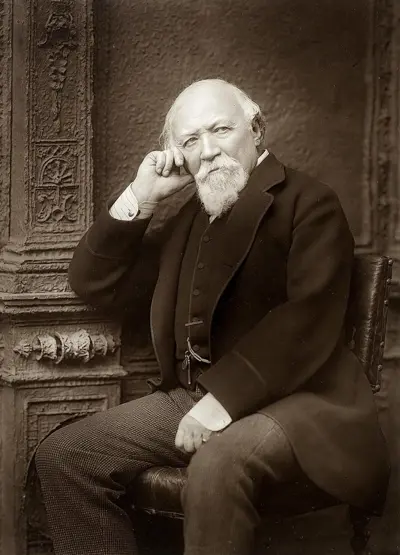
Robert Browning was an English poet and playwright whose dramatic monologues put him among the foremost Victorian poets. His poems are noted for irony, characterization, dark humour, social commentary, historical settings and challenging vocabulary and syntax. His career began well, but shrank for a time. The long poems Pauline (1833) and Paracelsus (1835) were acclaimed, but in 1840 Sordello was seen as wilfully obscure. His renown took over a decade to return, by which time he had moved from Shelleyan forms to a more personal style. In 1846 Browning married the older poet Elizabeth Barrett and went to live in Italy. By her death in 1861 he had published the collection Men and Women (1855). His Dramatis Personae (1864) and book-length epic poem The Ring and the Book (1868-1869) made him a leading British poet. He continued to write prolifically, but his reputation today rests mainly on his middle period. By his death in 1889, he was seen as a sage and philosopher-poet who had fed into Victorian social and political discourse. Societies for studying his work formed in his lifetime and survived in Britain and the United States into the 20th century.
