Aristotle Quotes
Men regard it as their right to return evil for evil—and if they cannot, feel they have lost their liberty.
Aristotle, 384-322 BC, Greek Philosopher & Teacher, Nicomachean Ethics
Sourced by: Eigen's Political and Historical Quotations


This proverb only makes sense in the light of understanding the Arab concept of revenge—“blood.” In a rural desert environment where little can be expected of government, the Arabs have developed a law enforcement and peace keeping mechanism which while primitive from modern standards, nevertheless worked to some degree. It is that revenge—“blood” is a moral necessity and obligation of all people, and revenge is not limited by time or to the individuals involved in the first incidence. The immediate family are the first to extract revenge, but the extended family follows and often the entire clan. Sometimes revenge is tribal or even national. Anyone who fails to revenge a member in his group is not only a disgrace, but is a clear and present danger to the group because then they can be attacked with impunity. So revenge is a strong obligation of the group members and blood must be paid with blood no matter how many generations it may take. The only thing that keeps me and my family safe, is the surety what whosoever kills one of us will themselves be killed or if they die a natural death we will take revenge on one of the evildoers relatives. Crime must never pay!


This sura on retaliation for murder is behind the Saudi Arabian law which allows the male relative of a murder victim to personally wield the sword in the beheading of the murderer.


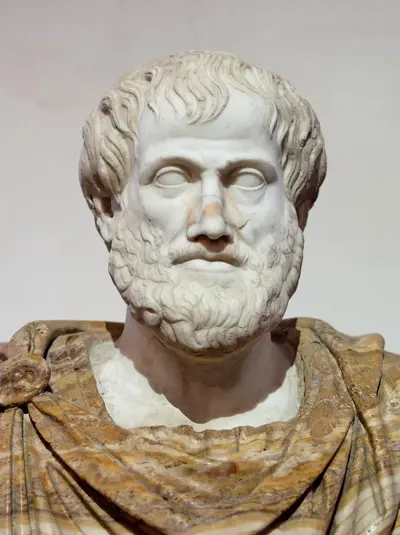
Aristotle (/ærɪˈstɒtəl/; Greek: Ἀριστοτέλης Aristotélēs, pronounced [aristotélɛːs]; 384–322 BC) was a Greek philosopher and polymath during the Classical period in Ancient Greece. Taught by Plato, he was the founder of the Lyceum, the Peripatetic school of philosophy, and the Aristotelian tradition. His writings cover many subjects including physics, biology, zoology, metaphysics, logic, ethics, aesthetics, poetry, theatre, music, rhetoric, psychology, linguistics, economics, politics, meteorology, geology and government. Aristotle provided a complex synthesis of the various philosophies existing prior to him. It was above all from his teachings that the West inherited its intellectual lexicon, as well as problems and methods of inquiry. As a result, his philosophy has exerted a unique influence on almost every form of knowledge in the West and it continues to be a subject of contemporary philosophical discussion.
