Bertrand Russell Quotes
... mathematical knowledge ... is, in fact, merely verbal knowledge. "3" means "2+1", and "4" means "3+1". Hence it follows (though the proof is long) that "4" means the same as "2+2". Thus mathematical knowledge ceases to be mysterious.
Russell, Bertrand. A History of Western Philosophy. Simon and Schuster, 1945, p. 830.

3rd Earl Russell of Kingston. In mathematics the numbers can count people, autos, sins, molecules, or paintings. The mathematician does not know or care. And the mathematics is the same regardless. And the fundamentals themselves are unknown. For example, what is a number? It’s not the symbol we write; that is a numeral. Some say that it is an abstract idea that represents a quantity like 5. But what is 5? That itself is an abstraction. So few mathematicians and no layman know what they are talking about when they do mathematics. Lord Russell, with his colleague Whitehead, built up a system where they could define a number as a set with certain properties. But they take 3 large volumes full of equations in a small type font to just get to 3rd grade arithmetic and knowing what they are talking about. In politics, we also often do not know what we are talking about, but that is for a much simpler set of reasons.


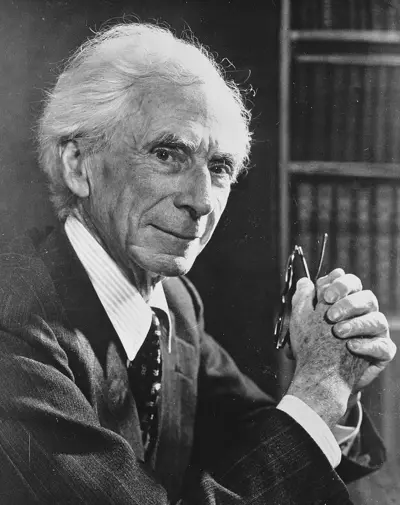
Bertrand Arthur William Russell, 3rd Earl Russell OM FRS was a British polymath, philosopher, logician, mathematician, historian, writer, social critic, political activist, and Nobel laureate. Bertrand Russell was one of the most influential and widely known intellectual figures of the twentieth century. In 1950 he was awarded the Nobel Prize in Literature for his extensive contributions to world literature and for his “rationality and humanity, as a fearless champion of free speech and free thought in the West.“
