Charles E. Coughlin Quotes
Many people are beginning to wonder who they should fear most - the Roosevelt-Churchill combination or the Hitler-Mussolini combination.
Coughlin was a great admirer of Adolf Hitler and Benito Mussolini and the Fascists. He was one of the American “heroes” in Nazi Germany, receiving assistance from the Nazi government. Between his anti-Semitism and support for Hitler, Fascism and radical socialism, the Vatican ordered him off the air and shut down his political demagoguery.
Charles E. Coughlin, 1891-1979, Catholic Priest, Union Party Co-founder, Social Justice, 1941
Sourced by: Eigen's Political and Historical Quotations

Browder, had been prohibited by Court Order from touring the country during the 1940 Presidential Campaign. He personally blamed FDR although the Communist vote was so small that no matter where and how Browder campaigned it would not have made any difference. However, the court order gave Browder the opening leading some to believe that the communist following was larger than it was—why else would the establishment want to keep the campaign limited?


Statement when she was told that FDR would run for a third term as President.


Donovan had been criticized for utilizing "leftists" for intelligence activities. Precursor to CIA. Donavan was a prominant attorney, banker and financier as well as a Medal of Honor Winner when he was asked to organzie the OSS. America was far behind the axis and even our allies in spy craft. J Edgar Hoover focused the FBI on leftists and had veritually no capability for spying in Western Europe and Asia. Donavan's OSS produced almost all of the actionable intelligence and did a wonderful job in organziaing covert operations. He used people who would normally never be considered by an espionage agency including many scholars, intellectuals, scientists, and entertainers. His agents ranged from Julia Child, the gourmet chef. to Moe Berg, a New York Yankee Baseball Player who spoke many languages. Hoover and some if the military intelligence agencies were jealous of his success and his access to President Roosevelt, and complained about anything they could find and hisi agents were an easy target for their wealth, societal connections, sexual indescretions, liberal politics, Bohemians, upper class right wing politics and culture. None of thus phased Donavan. After the war and FDR's death, Donavan's enemies got the OSS disbanded. Soon, something was needed, and the CIA was organized along the lines of Donavan's recommendations.


The military security people were so used to ferreting out communists in the 1930s that they had a hard time adjusting to the fact that the security risks or people who might have German connections or backgrounds. Many immigrant scientists were recruited for work on the Manhattan project to build the atomic bomb and they only did security clearances. The military security people kept checking on any communist background they might have had as opposed to possible connections with fascist organizations. By the end of the war they had adjusted but then had to go back to looking for communists as the Cold War evolved.

Although a fervent Nazi, he detested Hitler. When Hitler consolidated power, one of the first things he did in 1934 was to order his guards to murder Strasser, just as Strasser had feared.

Helms was then a young agent of the Office of Strategic Services (OSS) in Berlin.


While England was under attack by the Germans in World War II, Congress was debating Roosevelt's proposal for lend-lease. The president had set the passage of this legislation as his main priority, and a critical meeting between Churchill and Roosevelt was deferred until passage was obtained. Roosevelt dispatched Hopkins to London. Urging a prompt meeting, Hopkins cabled:


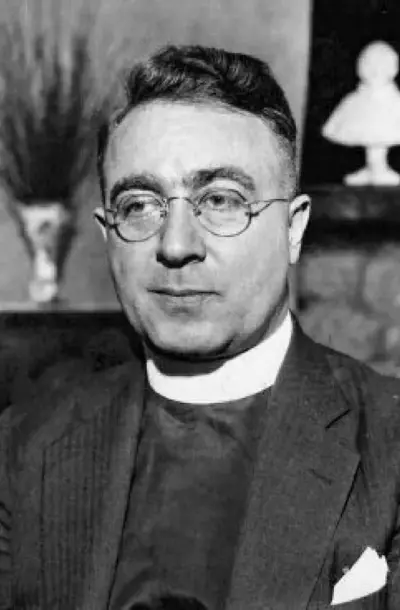
Charles Edward Coughlin, commonly known as Father Coughlin or the radio priest, was a Canadian-American Roman Catholic priest who was based in the United States near Detroit. He was the founding priest of the National Shrine of the Little Flower church. He was one of the first political leaders to use radio to reach a mass audience: during the 1930s, an estimated 30 million listeners tuned to his weekly broadcasts. He was forced off the air after his rhetoric became anti-Semitic and fascistic.
