Josiah Strong Quotes
Long before the thousand millions are here, the mighty centrifugal tendency, inherent in this stock and strengthened in the United States, will assert itself.
Strong, Josiah. Our Country: Its Possible Future and Its Present Crisis. The Baker and Taylor Co., 1885, p. 175.


At the time most people did not realize that the ability of a nation or land area to support a population was dependent more on agricultural and industrial productivity than on population size. In the most affluent and developed countries, land outside of the cities is quite affordable and available, whereas in poor, underdeveloped nations, land distribution and reform is still a factor. The majority of citizens of many developed, affluent nations do not own any land.


Julius Jacob von Haynau, 1786–1853, was a vicious Austrian General who had committed many atrocities in Italy and Hungary which today would be considered War Crimes and Crimes Against Humanity. He even had women publicly flogged who were heard saying anything sympathetic about the freedom fighters who the General suppressed brutally. Haynau was known and despised by military men the world over. So many of the Confederate and Union officers understood the insult. General Butler was not accused of atrocities of the usual type, but as the Commanding Union General of New Orleans, he was not very chivalrous to the Southern women of the city who were particularly effective in harassing the Union Officers and men. For example, the women would store the urine and feces of the chamber pots of the house and wait until Union soldiers, preferably officers, walked by and unloaded the waste on them from upper story windows. Butler ordered that women who harassed the soldiers could be “treated like common prostitutes.” Butler also turned a blind eye to the looting of the activist women’s silver and other valuables.


Ford, an inveterate racist and anti-Semitic in his old age was very liberal when he first started and accomplished so much. He not only hired foreigners, but also some men of his initial workforce were handicapped. He was proud of the fact that jobs could be created on his concept of an assembly line that was so specialized that handicapped people could be productive workers as they did not have to do everything in the manufacturing process. Since the assembly line did the moving, men who had trouble walking could sit and be very productive at some tasks. Further, Ford did not try and pay his assembly line workers less than the going wage because their skills could be much narrower. He actually doubled the salaries (see {642361}) and picked men who were not wed to the older, traditional way of manufacturing things. The productivity came from the engineering of the cars and the assembly line, not be cutting wages, a practice that he did not continue as he grew older and tried to make his money the traditional way of exploiting the workers more. When the other auto companies had recognized the union, the elder Ford would not.


This is an incredibly prescient quotation. Dewey saw globalization starting before most realized the change. He wrote this in 1916. Almost a century later, we live with the results of the process that he described.

“those lands” referred to large tracts of public land that was unoccupied.


The Interstate Commerce clause of the Constitution ensured that this would happen. It was so successful that the EEC and other groups of countries tried to emulate it by creating legal common markets.


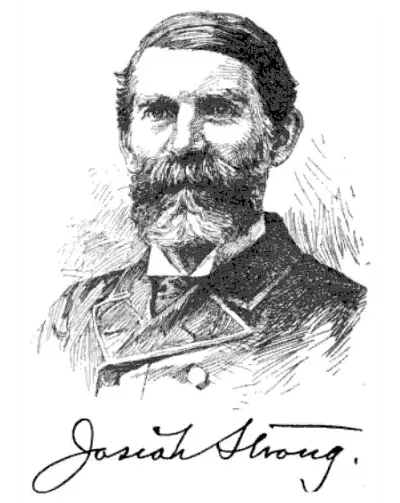
Josiah Strong was an American Protestant clergyman, organizer, editor and author. He was a leader of the Social Gospel movement, calling for social justice and combating social evils. He supported missionary work so that all races could be improved and uplifted and thereby brought to Christ. He is controversial, however, due to his beliefs about race and methods of converting people to Christianity. In his 1885 book Our Country, Strong argued that Anglo-Saxons are a superior race who must "Christianize and civilize" the "savage" races, which he argued would be good for the American economy and the "lesser races".
