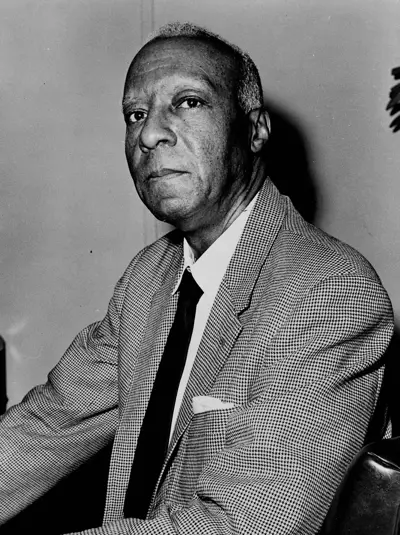
A. Philip Randolph Quotes
Lincoln merely nominally freed the bodies of Negroes. But Debs would free the bodies and minds of Negroes.
Randolph, A. Philip, and Chandler Owen. "Debs vs. Lincoln." The Messenger, vol. 2, no. 8, Sept. 1920, p. 84.

He was the Russian Reformer who ended serfdom and gave land to the peasants and then was assassinated. Ironically, both Alexander II and Lincoln were assassinated—because of their reform efforts—Lincoln for going too far; the Czar for not going far enough. See the Nickname that was given to the Czar: {622809}.


This Civil War recruiting poster was described by the Free Library of Philadelphia as “Civil War recruitment print targeting African Americans by evoking the freedoms granted by the Emancipation Proclamation. Depicts a montage of symbolic scenes centered around an African American Union soldier triumphantly holding up a sword and an American flag with the banner "Freedom to the Slave." He stands near broken shackles upon a tri-color flag adorned with a coiled snake. The flag is tugged upon by one of three joyous slaves freed by an African American soldier. Other scenes depict an African American man reading a newspaper on a rocking chair near a plow and child, African American children entering a "Public School" near a church, and a regiment of "U.S. Colored Troops" marching across a battlefield strewn with dead bodies.”
The first anti-slavery newspaper published in the United States & the first journal in America to advocate immediate, unconditional emancipation


Marx followed the American Civil War very closely. The freeing of the slaves caused an immediate social, moral and economic revolution, the results of which we live with today.


Earlier {629154} Smith was much more sympathetic with slavery. His views evolved as you can see by the comparison. He stated that he had a vision and made two prophesies {629156} that indeed came true. The last idea of slave buyouts seemed plausible to many abolitionists initially when they were not really knowledgeable about the economics of slavery. However, once they studied it, it became clear what it would not work even if the Southerners would then be willing to accept Blacks as free laborers which most were not, The two biggest problems were: 1) the international slave trade had been abolished. The only source of new slaves for growth was breeding them. Therefore, having slaves had TWO economic values—the work that they could do and the reproduction of themselves. A critical mass of owned slaves produced an income forever. And for Southerners who were culturally adverse to work (see {629169}), just having cash for their slaves was not enough. They were the servants, the farm labor, and their recreational sex. 2) and most important, the value or the slaves of the South was greater than the economic value of all the land, all the farms, all the buildings, all the factories, and all the inventory of the stores of the South all put together. The Southern slaves were the majority of the wealth of the south. There was no asset that could ever produce enough value to pay for the slaves—even over time. It would be like trying to buy all the shares of all the corporations in America today. There is no asset big enough to raise the money to ever finance it. The idea may have worked in Colonial America or even prior to the outlaw of the international slave trade, but by the time anyone took the idea seriously it was economically no longer feasible.


This was the first success that the anti-slavery forces of England had—the recognition and official classification of slaves as humans. After that, it was easier to abolish the slave trade which occurred 16 years thereafter.