Peter Bergen Quotes
Like the attack on Pearl Harbor, another hinge event in American history, 9/11 was a great tactical victory for America's enemies. But in both these cases, the tactical success of the attacks was not matched by strategic victories. Quite the reverse.
Bergen, Peter L. The Longest War: The Enduring Conflict Between America and Al-Qaeda. Free Press, 2011.


Some say that President Roosevelt had instructed the war department to issue warnings to the military forces in the Philippines and the Pacific. Military intelligence argued against the Japanese attack on the Philippines—and did not think any attack anywhere very likely. When the president insisted, warnings went out and this is what was sent to General Short. The warning was ambiguous and Short did very little and was caught unprepared shortly thereafter. How much reliance should be placed on intelligence estimates has been a question that has been argued before World War II and after.
Plan Orange was the code name of the united states plan for possible war with Japan. In this ironic quotation, American military planners realized five years before Pearl Harbor that surprise attack was the major vulnerability. We were surprised and had no help from our intelligence service which despite the recommendations was almost nonexistent.

There was a major leak of the administration’s contingency plans for war in Europe. FDR had run on a platform not to send American troops to Europe, and this leak, presented as a fete a compli, caused a political upheaval.


Washington, although the presiding officer of the Constitutional Convention, said almost nothing for such was the respect for him that he cou;d sway almost any issue. But the absurdity of limiting the size of the American Army was too much for him, and his clever way of phrasing his concern ended discussion of that idea without any ill feelings.

Germany had some world class physicists. Our scientists, military intelligence people, and political leadership assumed that the Germans were also seeking to develop the Atomic Bomb. Ironically, it turned out that they were not, and what Truman reported in this quotation was untrue (although that was not fully known at the time.) Einstein and several of the scientists who were early pioneers in modern physics were Jewish, and Hitler referred to the study of nuclear fission and fusion as “Jewish Science.” As a result, the German government did not commit the resources to the development of an atomic bomb. Instead, they were betting on the development of the Jet Airplane which they succeeded in deploying against the Allies at the end of the war. But they did not have enough or enough pilots left alive to fly them, and Germany was overrun by the Allied Troops. Prior to Truman’s erroneous report about the German development of an atomic bomb, there had only been one piece of evidence that the Germans were not developing one. An OSS secret agent, Moe Berg, had talked with Werner Heisenberg, at a Swiss scientific conference during the war. He was going to assassinate the greatest of the German physicists if Berg thought he was working on a nuclear device. Berg concluded from his discussions that Heisenberg did not know enough about nuclear fission to have been working on that. Berg did not kill Heisenberg, and reported that he did not think the Germans were developing a bomb as if they were Heisenberg would have been deeply involved. However, the American intelligence people and the American scientists, did not trust Berg’s analysis and conclusion. Berg was not a trained scientist. He was a professional baseball player—the NY Yankee backup catcher to Bill Dickey. He was a college graduate, a brilliant guy and a very fast learner who had studied physics books and papers before his assignment. Berg turned out to have been right, but that was not confirmed until a few years after the war. Truman had relied on an incorrect intelligence estimate when he made this quotation. It was not the first such error of intelligence analysis in American history and it would not be the last.
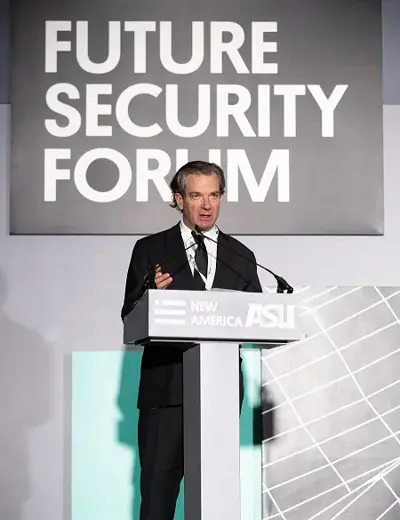
Peter Bergen is an American journalist, author, and producer who serves as CNN's national security analyst, New America's vice president, and as a professor of practice at Arizona State University. He produced the first television interview with Osama bin Laden in 1997. The interview, which aired on CNN, was the first time that bin Laden was interviewed by Western media.
