Benjamin Rush Quotes
Let our pupil be taught that he does not belong to himself, but that he is public property ... He must be taught to amass wealth, but it must be only to increase his power of contributing to the wants and demands of the state... [Education] can be done effectually only by the interference and aid of the Legislature.
Rush, Benjamin. "Of the Mode of Education Proper in a Republic." Essays, Literary, Moral and Philosophical, Philadelphia, Thomas & Samuel F. Bradford, 1798, pp. 14-15.


England did not follow this precept but the United States did and is the only country that did. In all others, education is controlled by the national government. However, Godwin's principle of separating education from government is not maintained in all the states of America. In many, the State government leaves much of the curriculum and the operations of the school to local school boards which have a great deal of discretion. However, in most of the Southern States, the State government dominates and controls education and relatively little is left to the school boards. In some the State chooses the allowable textbooks. In those cases, Godwin's principle is violated, but in most of the North East and Midwest and some of the far West the school boards have great autonomy and Goodwin's principle is upheld. It is fascinating that the more control a particular state exercises of the schools, the poorer the performance of the schools of that state. Goodwin had a terrific insight.


TR came from a wealthy, upper class family, and because of his position favoring regulation of corporations he was called a traitor to his class by many.


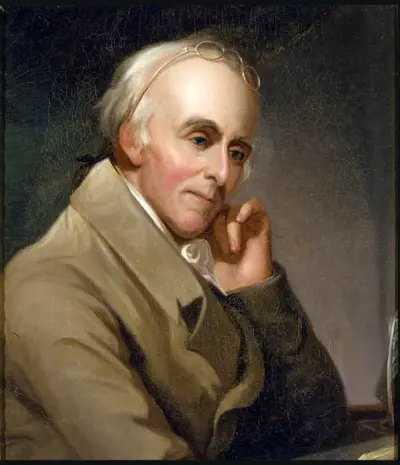
Benjamin Rush was a signer of the United States Declaration of Independence and a civic leader in Philadelphia, where he was a physician, politician, social reformer, humanitarian, and educator and the founder of Dickinson College. Rush attended the Continental Congress. His later self-description there was: "He aimed right." He served as Surgeon General of the Continental Army and became a professor of chemistry, medical theory, and clinical practice at the University of Pennsylvania.
