Lucretia Mott Quotes
Learning, while at school, that the charge for the education of girls was the same as that for boys, and that, when they became teachers, women received only half as much as men for their services, the injustice of this distinction was so apparent.
Hallowell, Anna Davis. James and Lucretia Mott: Life and Letters. Houghton, Mifflin and Company, 1884, p. 41.


He was a major critic of French Quebec Separatism and some elements of French Canadian culture including his perception of sexism. His French Quebec Separatist enemies translated passages of this work into French and (some say deliberately) mistranslated this line to read: Quebec women are sows. The quotation was bandied about Canada in the original version as well as the mistranslation.


Samuel Langhorne Clemens, 1835-1910. This is an excellent example of political sarcasm. Read literally, this quotation indicates that he was opposed to women’s suffrage, and was a fairly extreme sexist. What he was doing however, is stating publicly the argument that many men made at the time—especially those who were not highly literate or well-educated. By stating the argument of the opposition, he allows fair minded people to be exposed to views that they might otherwise not be exposed to. Many sexist men at the time read the quotation and, not appreciating Twain’s sarcasm, concluded that Twain, unlike most of the “egghead intellectuals” of the day was an opponent of the increasingly militant feminists. In actuality, Mark Twain was a strong feminist. See {630191}, {630192}, & {630193}.

There are two things that make this quotation interesting, First it tells us about the educational gender discrimination in early Massachusetts. But not his phrase “light soon broke in”. He obviously saw the lack of education for girls as undesirable and unenlightened. But the fact that he had this attitude and would express is so readily in 1857 tells us that, at least in the Northeast girls’ education was assumed by many as part of civilized society.


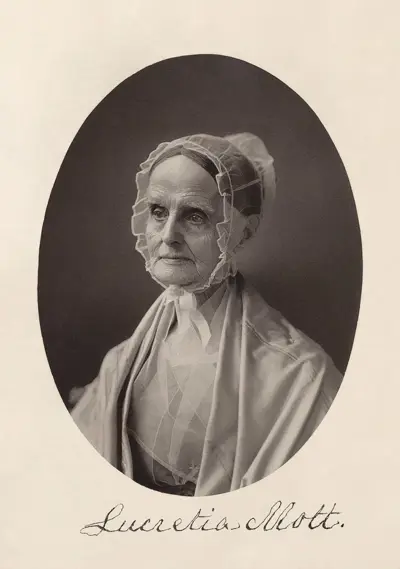
Lucretia Mott was an American Quaker, abolitionist, women's rights activist, and social reformer. She had formed the idea of reforming the position of women in society when she was amongst the women excluded from the World Anti-Slavery Convention held in London in 1840. In 1848 she was invited by Jane Hunt to a meeting that led to the first public gathering about women's rights, the Seneca Falls Convention, during which Mott co-wrote the Declaration of Sentiments.
