Lee Kun-hee Quotes
Korea can't become a 'first-class' nation unless regulation and 'a sense of power' disappear. The nation's politics is the fourth-class, bureaucratic are the third-class, and business is the second-class.
"Chronology of late Samsung Chairman Lee Kun-hee's key remarks." Yonhap News Agency, 25 Oct. 2020.


The Russian autocrat found it hard to believe that peasants and merchants could have any rights at all as they did in England. He faulted the female ruler, the great Queen Elizabeth I. By modern standards Elizabeth had awesome power and the English People very little, but Elizabeth was relatively restrained in her use of power and paid attention to the effect of affairs of state had on the people." Ivan the Terrible

This was a radical speech for the time, suggesting reforms that had been unthinkable to most Turks. Although it is not prohibited by the Koran and early Islamic artists made some of the greatest paintings and depictions of people, fundamentalists gained control of Islam and interpreted any statue as an idol that could be worshipped and this generalized to Islamic art in general where people ceased to be depicted and even animal depictions were rare. Muslim art developed incredible geometric intricacy but tended not to depict anything that is real. This extended to photography and illustrations in books including textbooks. At the same time, not unlike some Christian and Jewish Fundamentalists, the Muslim fundamentalists opposed science and the teaching thereof on the grounds that all authentic knowledge was in the Koran and anything else was not only false but also heretical. So this speech was a type of “declaration of war” against the established religious order and culture.
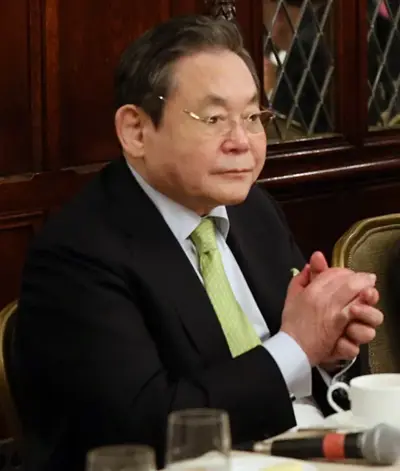
Lee Kun-hee was a South Korean businessman who served as chairman of the Samsung Group from 1987 to 2008 and from 2010 to 2020, and is credited with the transformation of Samsung to the world's largest manufacturer of smartphones, televisions, and memory chips. He was also a member of the International Olympic Committee. He was the third son of Samsung founder Lee Byung-chul. With an estimated net worth of US$21 billion at the time of his death, he was the richest person in South Korea, a position that he had held since 2007.
